

Recognize possible menopause-related changes without diagnosing yourself
Possible menopause-related changes can begin before your final menstrual period, so a new symptom is a pattern to notice rather than proof of a diagnosis. Common changes may involve hot flashes, sleep disturbance, mood changes, memory complaints, or vaginal dryness. The range is broad, and the same symptom can have causes unrelated to reproductive aging.
The menopausal transition may begin four to six years before periods stop and can involve hot flashes, sleep disturbance, mood changes, memory complaints, and vaginal dryness. Other findings indicate that symptoms often emerge during the early transition rather than only after menopause or in your 50s. These points do not create a personal timetable; the useful starting point is to record what changed, when it changed, and how it affects your day.
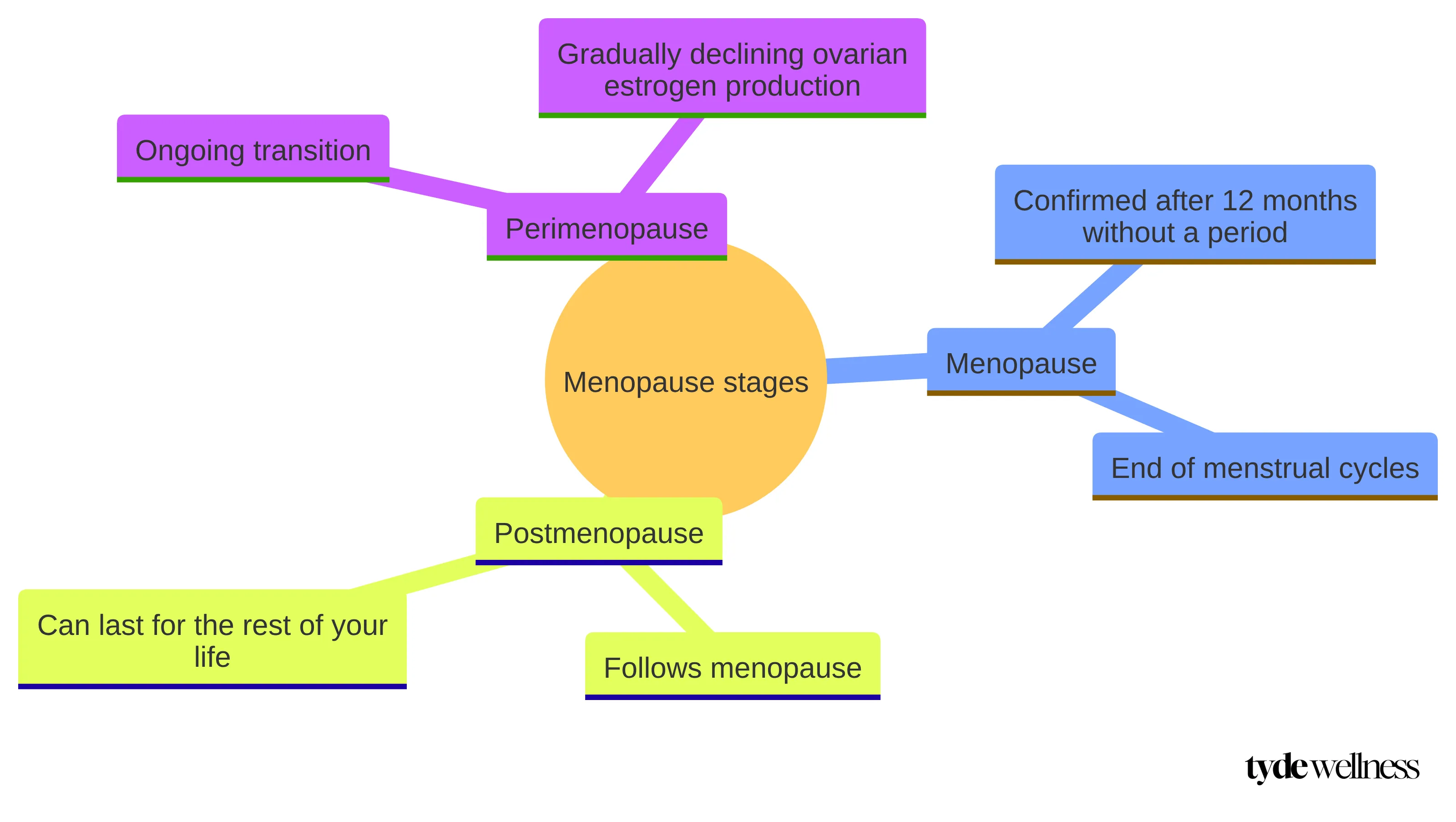
Perimenopause is the transition when ovarian estrogen production gradually declines. A clinician confirms menopause after 12 months without a period, and postmenopause follows that point. Describe symptoms accurately, keep their timing alongside menstrual changes, and avoid treating a symptom list as a self-diagnosis.
Know the difference between perimenopause, menopause, and postmenopause
The menopause transition has three useful stage descriptions, and each term refers to something different. The distinctions below can help you describe your situation without assuming that a symptom confirms a stage.
| Stage | What the term describes | Practical meaning |
|---|---|---|
| Perimenopause | An ongoing transition in which ovarian estrogen production gradually declines | Symptoms and menstrual changes may occur before the final period |
| Menopause | A point confirmed by a clinician after 12 months without a period | The term refers to the confirmed end of menstrual cycles, not to every symptom you may experience |
| Postmenopause | The stage that follows menopause and can last for the rest of your life | Later symptoms still deserve attention rather than automatic attribution to menopause |
The word “menopause” is often used broadly in everyday conversation, but the stage distinction matters when you describe timing. Record your menstrual pattern alongside other changes. If you are unsure which stage applies, bring the pattern to a clinician rather than trying to settle the question from symptoms alone.
Expect symptom timing and transition length to vary
Menopause timing varies across people, so an age-based prediction cannot tell you exactly when changes will begin or end. The menopausal transition may begin four to six years before periods stop, while other findings describe symptoms as often appearing during the early transition. Both points support paying attention before the final period rather than waiting for a later milestone.
For the groups measured in one cohort, the transition lasted a median of four or more years. Median onset occurred at age 47, the late transition at a median age of 49, and the final menstrual period at ages 51 to 52. These are group findings, not a forecast for you. The same data showed different median durations among symptom-onset groups: 8.6 years for the earliest-onset group and 4.3 years for the later-onset group.
Use timing as context, not as a test. A change that appears earlier, later, or in a different order does not by itself confirm or exclude a menopause-related explanation. Write down changes in periods, temperature sensations, sleep, mood, cognition, and vaginal or sexual comfort so the sequence can be discussed rather than guessed.
Transition length also does not tell you how severe your experience will be. Two people can move through the stages on different schedules and have different combinations of symptoms. Your own record should therefore emphasize the pattern and daily effect, not whether your timing matches a group median.
Map physical and vasomotor symptoms
Hot flashes and other vasomotor symptoms are common physical features of the menopause transition. You may notice a sudden sensation of heat, episodes that disturb your routine, or changes that occur alongside sleep disruption or mood symptoms. Urogenital changes may also affect sexual desire, so physical and sexual concerns can belong in the same record without being treated as the same symptom.
The reported groups included vasomotor symptoms in 32% of premenopausal women and 66% of perimenopausal women. Those percentages describe the groups measured; they do not establish whether your own symptoms are related to menopause. Severity also differs. For some women, changes are severe or disabling and disrupt work or family life, while other symptoms have limited daily impact.
Record the symptom in concrete terms:
- What did you feel, and how long did the episode last?
- When did it happen, and did it interrupt work, sleep, exercise, or family responsibilities?
- Did it occur with a period change, sleep problem, mood change, or another new symptom?
- How often did it happen, and did the pattern change over several days or weeks?
A concrete description gives a clinician more useful information than a general label such as “hormonal.” It also helps you distinguish a single event from a recurring pattern without deciding the cause in advance.
Include sleep disruption in the symptom picture
Sleep disruption can appear as trouble falling asleep, difficulty staying asleep, waking earlier than planned, or sleep that does not leave you feeling refreshed. Nighttime hot flashes may be part of the picture, but a sleep complaint should remain a sleep complaint in your notes rather than being automatically assigned to menopause.
In the measured group, difficulty falling asleep occurred in 29% of women, and early awakening with an inability to return to sleep occurred in 21%. These figures describe that group and do not predict your sleep pattern. Record bedtime, estimated time to fall asleep, nighttime awakenings, early waking, and how refreshed you feel the next day.
Sleep notes can also capture context that changes how you interpret the pattern. Add nighttime heat episodes, stress, changes in mood, alcohol or caffeine use if relevant to your own record, and medication changes you plan to mention. Note whether poor sleep affects concentration, work, caregiving, exercise, or relationships.
Persistent sleep disruption that affects your quality of life belongs in a clinical conversation, especially when the cause is uncertain. Tracking can describe the problem; it cannot determine whether the cause is menopause, another health issue, or a combination of factors.
Notice mood and cognitive changes while considering other explanations
Mood and cognitive changes can occur during the menopause transition, but they should not be reduced to a hormone explanation without context. Anxiety, mood swings, and depression are common during perimenopause, particularly with severe vasomotor symptoms or a history of depression. Low mood that is new, persistent, or disruptive deserves attention in its own right.
Cognitive complaints may include difficulty remembering names or spoken information, organizing, planning, or concentrating. In one study of 205 menopausal women, 72% reported some subjective memory impairment. Cognitive symptoms were more prevalent early in the transition in the findings described, but they were more closely associated with perceived stress or depressive symptoms than with perimenopausal stage.
A symptom log can separate the experience from the interpretation. Write down:
- The specific task that became difficult, such as recalling a name, following spoken information, planning, or concentrating.
- The time of day and whether poor sleep, stress, or low mood occurred at the same time.
- How often the problem occurred and whether it affected work, driving, caregiving, communication, or another daily responsibility.
- Any history of depression or a meaningful change in mood that you want to discuss.
Mental health history can change the clinical context. Midlife recurrence of major depressive disorder was reported at 59% among women with a history of the condition, compared with 28% among women without that history. Those figures do not diagnose a recurrence in you; they support bringing mood history and current symptoms into the same conversation.
If cognitive or mood changes interfere with safety, essential responsibilities, or your ability to function, do not wait for a symptom log to provide an explanation. Arrange clinical evaluation and describe the change in specific, observable terms.
Include sexual and genitourinary changes in your symptom map
Sexual and genitourinary changes deserve a place in your symptom map rather than being left out because they feel private. Urogenital changes may affect sexual desire, and vaginal dryness is among the possible changes during the transition. Your notes do not need intimate detail; they need enough information to show what changed and whether it affects comfort, sexual activity, sleep, or daily life.
Track the timing and pattern of vaginal or genitourinary discomfort, changes in sexual desire, and any relationship to menstrual changes or other symptoms. You can use direct but simple language, such as “new discomfort,” “less desire,” or “dryness during intimacy.” Use your own words when you speak with a clinician.
Persistent symptoms or unexplained changes should be evaluated rather than assumed to be menopause-related. Vaginal or pelvic concerns can feel difficult to raise, but leaving them out makes the overall pattern less complete.
Track symptoms as patterns instead of isolated events
A symptom record turns scattered experiences into a timeline you can use for a clinical discussion. Keep the record simple enough to maintain, and separate what you observed from what you think caused it. A daily or several-times-weekly format can include:
- Date and stage context: Record the date, menstrual timing or bleeding changes, and whether you consider yourself in an ongoing transition, after 12 months without a period, or uncertain about the stage.
- Symptom domain: Label the entry as a hot flash or other physical change, sleep, mood, cognition, sexual concern, or genitourinary concern.
- Description: Write what happened in plain language, including duration, frequency, intensity, and any pattern you noticed.
- Daily impact: Note effects on work, caregiving, exercise, relationships, concentration, or sleep.
- Related context: Add changes that may help with interpretation, such as stress, sleep quality, mood, or medication changes.
- Question for follow-up: Record what you want clarified rather than trying to answer it yourself.
A structured symptom tool, such as the Greene Climacteric Scale or Menopause Rating Scale, can help you track symptoms and changes over time. You can use a recognized tool, a paper calendar, or a private digital note; the immediate purpose is to preserve timing and impact for discussion.
Review the record before an appointment and mark two or three patterns that matter most. For example, you might notice that sleep disruption occurs after nighttime heat episodes, that concentration is worse after poor sleep, or that a genitourinary concern has persisted. These observations are not conclusions, but they give you clear questions to bring forward.
Avoid changing several health routines at once just to test a theory, because a symptom record works best when it describes what happened rather than forcing a conclusion. Keep the format manageable. A brief consistent entry is more useful for a conversation than a detailed record you cannot maintain.
Use persistence, daily impact, and concerning changes to decide when to seek evaluation
The decision to seek evaluation should reflect persistence, effect on your quality of life, and the nature of the change—not just whether a symptom appears on a menopause checklist. A limited symptom pattern that is changing can be recorded while you arrange an appropriate conversation, but ongoing disruption is a reason to move from tracking to evaluation.
Seek clinical evaluation for symptoms that persist and affect your quality of life. Concerning changes also warrant evaluation, including postmenopausal or unexplained vaginal bleeding and persistent pelvic or abdominal pain. Do not use a symptom tracker to postpone care for a concerning change.
Use this decision path:
- Monitor and record: Choose this for a limited or changing pattern that is not substantially affecting daily life, while keeping track of what happens next.
- Arrange a clinical discussion: Choose this when symptoms persist, disrupt sleep or daily responsibilities, affect your quality of life, or remain difficult to explain.
- Seek evaluation for a concerning change: Choose this for postmenopausal or unexplained vaginal bleeding or persistent pelvic or abdominal pain.
This path does not identify the cause. It helps you match the next conversation to persistence, impact, and the type of symptom you are experiencing. If you are unsure which branch fits, describing the uncertainty to a clinician is itself a reasonable next step.
To apply this path consistently, separate four observations instead of reducing a symptom to a single severity label: frequency, duration, intensity, and impact. Frequency describes how often it happens. Duration describes how long it lasts. Intensity describes how strong it feels. Impact describes what it prevents or changes. A symptom can be infrequent yet worth discussing if it interrupts sleep, work, caregiving, or relationships. A frequent but limited symptom may be suitable for continued recording when it is changing and not substantially affecting daily life. This comparison does not identify a cause; it makes the reason for your next step clearer.
Persistence is another question. A pattern may recur over time without being constant, so note recurrence rather than waiting for a symptom to occur every day. Conversely, a new change that has not had time to establish a pattern can still be important if it is concerning or causes substantial disruption. The type of change can therefore outweigh duration: postmenopausal or unexplained vaginal bleeding and persistent pelvic or abdominal pain should not be treated as ordinary entries simply because other symptoms are mild.
When several domains occur together, record their order and overlap. For example, note whether sleep disruption preceded concentration difficulty, whether heat episodes woke you, or whether mood changes occurred during the same period. These observations can help a clinician consider menopause alongside stress, depressive symptoms, or other explanations without turning sequence into proof. At the end of each week, identify the one pattern with the greatest daily effect and the one question you cannot answer from your notes. Those two items can guide whether to keep monitoring or arrange a discussion.
Prepare focused questions for a clinician
A focused appointment begins with a focused account of what changed. Bring your symptom record and organize your questions around timing, patterns, and daily impact rather than asking whether a single symptom proves menopause.
Questions you can bring include:
- Could my menstrual pattern and symptom timing fit a menopause transition, or should we consider other explanations?
- Which details about my hot flashes, sleep, mood, memory, concentration, vaginal comfort, or sexual desire are most useful to record?
- How does my medical history, family history, or current medication list affect the discussion?
- What changes should prompt me to contact you again?
- Which options are available if symptoms continue to affect my quality of life?
- What are the differences between lifestyle changes, nonhormonal medicines, and hormones for the symptoms I want to address?
- How should my preferences and concerns shape the decision?
Many women do not need treatment for menopause symptoms. If you want treatment, discuss lifestyle changes, nonhormonal medicines, or hormones with a doctor who can consider your symptoms, medical and family history, and preferences. The goal of the appointment is not to collect every possible symptom; it is to give the clinician enough context to evaluate your concerns and explain the available choices.
Bring a short summary if the full record is long. Include when the change began, how often it occurs, what makes it better or worse if you have noticed a pattern, and what daily activity it affects. This keeps the conversation focused without requiring you to explain every entry.
Organizing questions by purpose can make the appointment easier to navigate. Timing questions ask when the change began, how it relates to menstrual timing, whether it has recurred, and whether it is changing. Symptom questions describe the domain involved and the concrete experience rather than relying on a broad label. Context questions cover sleep, mood, stress, medical history, family history, and current medicines. Decision questions ask what should be monitored, what warrants evaluation, and which options may be discussed if a symptom continues to affect quality of life.
When more than one domain is involved, describe the sequence instead of presenting every change as one problem. For example, you can explain that a sleep change appeared alongside nighttime heat episodes, or that concentration became more difficult after several nights of poor sleep, while making clear that the sequence is an observation rather than a conclusion. A clinician can then consider whether the pattern fits the menopause transition, whether another explanation needs attention, and what additional context matters.
It can help to separate questions about meaning from questions about next steps. “What might explain this pattern?” is different from “What should I track?” or “When should I contact you again?” If treatment is discussed, ask which symptom the option is intended to address and how your medical history, family history, and preferences enter the decision. This keeps a treatment conversation focused on a stated concern rather than on the assumption that every change has one cause.
A short opening summary can keep the visit focused: state the main change, when it began, the other domains involved, the effect on daily life, and the question you most want answered. Then use the record for detail. This approach leaves room for the clinician to ask about symptoms that seem less prominent, consider causes other than menopause, and explain whether monitoring or further evaluation is appropriate.
Separate menopause symptoms from weight-management concerns
Weight-management concerns can overlap with sleep, stress, mood, and menopause-related changes without proving that menopause caused a specific weight change. Guidance on midlife weight states that poor sleep and high stress are closely tied to weight gain, while good sleep and stress management can make maintaining a healthy weight easier. That relationship gives you a reason to record sleep and stress alongside eating patterns and activity, not a reason to assign every change to hormones.
Hormone therapy is not a direct weight-loss treatment. It may ease hot flashes, sleep disturbances, and mood swings, which can make lifestyle changes more manageable. That distinction matters: treatment aimed at symptoms and support aimed at weight management may overlap in the broader conversation, but they do not have the same purpose.
Clinically significant weight loss was associated with improvement in hot flashes, mood disorders, and sleep disturbances in a perimenopause weight-management review. The same review noted that achieving that degree of weight loss can be more challenging during perimenopause. An association does not establish that weight loss will relieve your symptoms, and it does not establish that a symptom caused your weight change.
Keep the questions separate:
- Symptom question: What could explain my hot flashes, sleep disruption, mood changes, cognitive concerns, or genitourinary symptoms?
- Weight question: What factors may be affecting my weight, appetite, routines, sleep, or stress, and what support should I discuss?
- Connection question: Could the same context be affecting both concerns, and what needs its own evaluation?
A sustainable weight-management conversation can include sleep, stress, eating patterns, activity, and medical context without requiring a restrictive diet or treating weight as a test for menopause. Keep the intended outcome explicit. If the goal is symptom relief, discuss that symptom; if the goal is weight management, discuss that concern separately.
This separation protects you from treating weight change as proof of menopause or treating menopause symptom care as a promise of weight loss.
Keep treatment decisions individualized
Treatment goals should stay specific. You might want to discuss sleep disruption, hot flashes, low mood, cognitive concerns, vaginal dryness, or another concern rather than asking for a general menopause treatment. A specific goal makes it easier to describe what you hope will change and what would count as a reason to reassess.
Weight concerns should remain a separate part of that discussion. Hormone therapy is not a direct weight-loss treatment, even though easing hot flashes, sleep disturbances, or mood swings may make lifestyle changes more manageable. Ask about each intended outcome directly, and do not treat improvement in one area as proof that another area will improve.
Choose an informed next step without overinterpreting symptoms
Your next step can follow a simple sequence: identify the possible stage, map physical, sleep, mood, cognitive, sexual, and genitourinary changes, record timing and daily impact, and consider that symptoms may have causes other than menopause. Monitor a limited changing pattern when appropriate, but arrange clinical evaluation when symptoms persist, affect your quality of life, or include postmenopausal or unexplained vaginal bleeding or persistent pelvic or abdominal pain.
A qualified clinician should decide what an individual symptom means and whether any treatment is suitable after considering your symptoms, medical and family history, and preferences. Keep menopause symptom evaluation separate from any conversation about weight-management support, so neither concern is treated as proof of the other. If you want treatment, bring your symptom record and focused questions to the appointment.

