

The label does not make the decision
The label “fat loss peptide” describes a broad category, not a complete treatment profile. The selected overview distinguishes FDA-approved peptide medications from peptides described as still in clinical trials and from unregulated or “grey market” peptides sold online, which it says are not FDA approved and may carry safety and quality risks.
A more useful evaluation starts with four questions:
- What exactly is the product, active ingredient, and intended use?
- Is it an approved treatment, an investigational product, or an unverified product sold outside an established approval pathway?
- What outcome does the evidence measure: appetite, body weight, fat mass, lean mass, or another result?
- What medical history, current medications, and follow-up questions belong in the discussion before you consider it?
This approach keeps a promising mechanism from doing more work than the evidence allows. It also helps you separate information about a category from a decision about a specific product. The goal is not to find the most persuasive label. The goal is to determine what is established, what remains uncertain, and what requires a clinician’s review.
What peptides do in weight regulation
Peptides are chemical messengers that can participate in appetite, digestion, and metabolism. Some peptide-based medications mimic or enhance signals involved in these processes, which is why peptide treatments are discussed in relation to weight management.
The body’s energy-balance system includes different signals with different effects. Some neuropeptides stimulate appetite, while others suppress food intake. These signals interact with neural and hormonal systems that help regulate energy balance, rather than acting as a single on-or-off switch.
That distinction matters when you interpret a product description. A treatment that affects appetite signaling may change how hungry you feel or how much you eat, but those effects do not automatically tell you how much fat mass or lean mass will change. A change on the scale also does not explain which tissues account for that change.
Use the mechanism as an explanation, not as a result claim. When a product description says that a peptide works on appetite or metabolism, ask which specific outcome was measured in human studies, over what period, and in which population. A biological explanation can make a treatment plausible; it cannot replace outcome data or a safety review.
Sort the product before judging the promise
Product category determines how you should read the promise. For practical purposes, sort the option into an approved treatment, an investigational product, or an unverified product before comparing its claims with your goals.
GoodRx’s overview published April 3, 2026, identified Zepbound, Wegovy, and Saxenda as FDA-approved peptide medications for weight loss, counting Wegovy’s injection and pill forms separately. That attribution and date matter because medication approvals, formulations, indications, and availability can change.
The same overview described retatrutide, survodutide, and VK2735 as peptides still in clinical trials. A clinical-trial product belongs in a different evidence category from an approved treatment: promising findings do not make the product an established option for general use.
The overview also stated that unregulated or “grey market” peptides sold online are not FDA approved and may carry safety and quality risks. Treat a product’s online availability as separate from its regulatory status. A product can be easy to find without having the evidence, quality controls, or approval status you would expect from an established treatment.
For any option you are considering, write down its exact name, active ingredient, stated use, and category as of the date of your consultation. If a seller uses only a broad marketing label or does not clearly identify the product, that is a reason to pause the evaluation rather than fill in the missing details yourself.
Match the evidence to the outcome
Evidence is useful only when the measured outcome matches the question you are asking. Appetite, total body weight, fat mass, lean mass, and physical performance are related but different outcomes.
A study can show a change in body weight without showing how that change was distributed between fat and lean tissue. A body-composition study can describe tissue changes without establishing what you will experience. A study of appetite can explain a possible pathway without demonstrating a particular amount of weight loss.
A systematic review and meta-analysis in adults with overweight or obesity without type 2 diabetes found that GLP-1 receptor agonists reduced both fat mass and lean mass more than control interventions, with fat mass accounting for most of the observed tissue loss. The analysis included only three randomized controlled trials, so its findings require caution.
Use the evidence question that fits your decision:
- If your question is about appetite, look for appetite-related outcomes rather than relying on a general metabolism claim.
- If your question is about weight, check the study population, comparison group, duration, and measured change.
- If your question is about fat loss, look for body-composition data instead of treating total weight as a direct measure of fat mass.
- If your question is about strength or function, look for those outcomes specifically; body weight and lean mass do not answer them by themselves.
This prevents a result in one category from being presented as proof in another. It also makes uncertainty easier to see.
To make that comparison concrete, keep an evidence note with one line for each outcome you care about. For each line record the measure used, the study population, the comparison group, the duration, and the main limitation. Then label the conclusion narrowly: “supports an appetite effect,” “reports weight change,” or “provides body-composition evidence.” If a study does not measure fat mass, do not convert its weight result into a fat-loss result. If it does not assess strength or function, do not use lean-mass data as a substitute. This small record makes it easier to compare claims without treating every peptide-based study as evidence for the same outcome.
Read lean-mass findings with appropriate caution
Lean-mass findings need careful reading because lean mass is not identical to skeletal muscle. Lean mass can include muscle along with organs, bone, fluids, and water in fat tissue, so a reported lean-mass change does not by itself describe a change in muscle strength or physical function.
Reviews of GLP-1-based treatments also describe substantial variation between studies. Some studies reported lean-mass reductions equal to 40%–60% of total weight lost, while others reported reductions of about 15% or less. The reported range differs with factors such as the population studied, the specific molecule, related health conditions, and how body composition was measured.
That variation is not a reason to select the most reassuring number or the most alarming one. It is a reason to ask what the study measured and how closely its participants and treatment conditions resemble the question you are bringing to care.
Keep three distinctions in view:
- Lean mass is a measurement category, not a direct synonym for muscle.
- A proportion of total weight lost is not the same as a percentage of starting body weight.
- A study result describes the study conditions; it does not set an individual expectation.
These distinctions help you discuss body composition without turning an uncertain area of evidence into either a guarantee or a warning detached from context.
Use body composition as a quality check
Body composition gives you a more useful quality check than scale weight alone, while still leaving meaningful questions unanswered. The available meta-analysis found reductions in both fat mass and lean mass, with most observed tissue loss coming from fat, but it included only three randomized controlled trials and called for cautious interpretation.
The review supports discussing adequate nutritional intake and regular physical activity, particularly resistance exercise, alongside medication. It also notes that long-term effects and outcomes such as muscle strength and physical performance need further study.
Turn that evidence into practical questions rather than a rigid self-directed plan:
- Which outcome will we track besides total weight?
- Would body-composition measures add useful information in my situation, and what are their limits?
- How should nutrition and physical activity fit alongside treatment?
- What would count as a reason to reassess the plan?
The point of these questions is not to promise that a particular routine will prevent a particular tissue change. The point is to keep the quality of weight change in the conversation and to avoid judging progress from one number alone. A thoughtful evaluation can consider weight, body composition, nutrition, activity, and function without pretending that each measure tells the same story.
Verify the product before trusting the promise
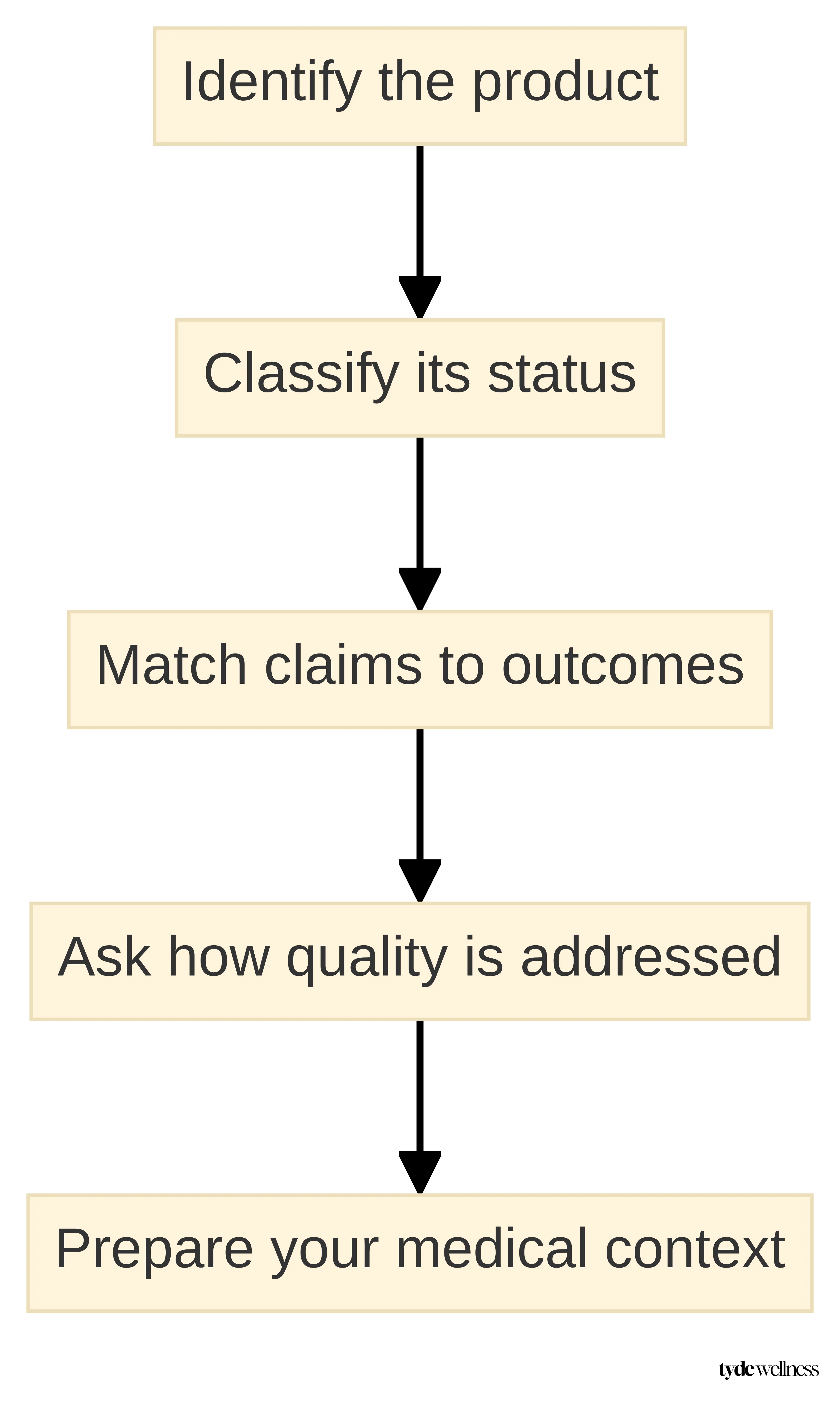
Product verification comes before promise evaluation. Before you spend money or discuss a treatment change, organize the information that would let you distinguish a named medical product from a vague or unverified marketing offer.
Use this checklist:
- Identify the product. Record the exact product name, active ingredient, formulation, and stated purpose.
- Classify its status. Ask whether it is an approved treatment for the stated use, an investigational product in clinical trials, or an unregulated product sold outside an established approval pathway.
- Match claims to outcomes. Separate claims about appetite, scale weight, fat mass, lean mass, strength, and long-term maintenance.
- Ask how quality is addressed. For an online or grey-market product, ask what information establishes its identity, quality, and handling. The reviewed GoodRx overview states that unregulated or grey-market peptides may carry safety and quality risks.
- Prepare your medical context. Bring your health history, prior weight-loss efforts, lifestyle context, and current medication list to the discussion.
A clinician’s evaluation of a weight-loss medication may include BMI, weight-related health conditions, previous weight-loss efforts, lifestyle, medical history, current health status, underlying conditions, and current medications that could promote weight gain or interact with treatment. Those details connect the product question to your circumstances instead of leaving the decision at the marketing level.
If you cannot answer the first two checklist items, you do not yet have enough product information to judge the promise.
Build the clinician conversation around safety
Safety questions should connect the product to your medical history, current medications, and the outcomes that need follow-up. A general description of how a peptide works cannot identify every factor that matters in your situation.
Bring a written list of questions such as:
- Which parts of my medical history are relevant to evaluating this type of treatment?
- Could any current medication promote weight gain or interact with a weight-loss medication?
- What outcome are we trying to change, and how will we distinguish weight change from changes in fat mass or lean mass?
- What follow-up information would show that the plan needs reassessment?
- If the product is investigational or unregulated, what does that mean for the evidence and quality information available to me?
- Which questions remain unanswered because the available studies did not measure long-term effects, strength, or physical performance?
The clinician-evaluation framework described in the cited medical guidance includes health conditions, prior weight-loss efforts, lifestyle, medical history, current health status, and current medications. Use those topics as prompts, not as a checklist that decides the outcome in advance.
The body-composition evidence adds another reason to ask about follow-up. Reported lean-mass changes vary across GLP-1-based studies, and the available review recommends discussing nutrition and regular physical activity, particularly resistance exercise, alongside medication. Your conversation should therefore cover both the product and how the broader plan will be assessed over time.
Avoid reducing safety to a single question such as whether a product is “natural,” popular, or easy to obtain. Safety depends on the product’s status, the evidence behind its use, your medical context, current medications, and the way follow-up is handled.
One practical way to prepare is to organize your notes in four parts: product, personal context, outcomes, and follow-up. Under product, record the exact identity and status. Under personal context, list the health history and medications you want the clinician to review. Under outcomes, state whether your question concerns appetite, weight, fat mass, lean mass, strength, or function. Under follow-up, ask how those outcomes and unresolved uncertainties will be revisited. This format does not determine eligibility or tell you what treatment to choose; it makes information gaps visible so the clinician can address them directly. If the product is investigational or unverified, include that status in the notes rather than treating it as a minor detail.
Use shared decision-making to test fit
Shared decision-making gives you a way to weigh evidence against practical fit without treating either one as the whole answer. In a mixed-methods study published July 30, 2026, 103 adults seeking specialized weight-management care considered desired weight loss, provider recommendations, and treatment cost when considering options.
The same study found that participants valued shared decision-making and personalized guidance. Interviews also showed that participants considered both personal stories and medical information. That finding does not make a personal story equivalent to clinical evidence, but it does explain why a treatment decision can feel complicated even after you have read the basic facts.
Use the conversation to put the tradeoffs in plain language:
- What outcome matters most to you: appetite, weight, body composition, function, or another health goal?
- What uncertainties are you willing to live with, and which ones need an answer before you proceed?
- What cost, communication, and follow-up requirements fit your life?
- What would make you pause, ask for more information, or reconsider the option?
A treatment can have evidence behind it and still raise practical questions about access, follow-up, cost, or personal priorities. Conversely, a convenient option can still lack the evidence or product information needed for a sound decision. Shared decision-making keeps both sides visible.
Recognize what general information cannot establish
General information can explain peptide categories, evidence types, and questions to ask, but it cannot establish whether a specific product fits your health history. A product label cannot determine your individual suitability, provide dosing instructions for you, or replace a review of current medications and possible interactions.
General information also cannot turn an investigational result into an approved treatment, or turn a scale change into a body-composition result. The cited GoodRx overview separates approved medications from peptides described as still in clinical trials and from unregulated products that may carry safety and quality risks. The body-composition review likewise cautions that its findings came from only three randomized controlled trials.
Use those boundaries to interpret claims more carefully:
- “Works on appetite” describes a mechanism, not a guaranteed weight outcome.
- “Produced weight loss” does not specify how much came from fat or lean mass.
- “In a trial” does not mean the product has an established status for your intended use.
- “Available online” does not establish quality or safety.
The practical conclusion is narrow but useful: you can use public information to prepare a better discussion, classify the questions that remain, and avoid treating a marketing label as a medical decision.
Understand what clinician-guided support can add
Clinician-guided support can add a structured place to connect product questions with your health context. Tyde Wellness offers personalized medical weight-loss services, provides GLP-1 and non-GLP-1 options for weight loss, and offers real-time messaging with its care team.
Those business facts describe available service categories and communication support. They do not establish that a specific peptide, medication, or treatment plan is appropriate for you. They also do not turn a broad label into a conclusion about your medical history, current medications, or treatment goals.
If you explore a personalized service, use the discussion to keep the evaluation specific:
- Name the exact product or category you want to understand.
- Ask which evidence applies to the outcome you care about.
- Bring your current medication list and relevant health history.
- Ask how weight, body composition, nutrition, activity, and follow-up will be discussed.
- Separate a service’s available options from the decision about what fits your circumstances.
This is the useful connection between general education and care: the service can provide a setting for a more individualized conversation, while the product’s evidence, status, risks, and unanswered questions still need to be addressed directly.
When evaluating a clinician-guided service, keep the service question separate from the product question. Verify what kind of clinician review is available, what information you should bring, and how you can ask follow-up questions; do not treat real-time messaging or the existence of more than one option as evidence that any option is suitable. You can also ask how the conversation will distinguish a general educational explanation from an individualized medical decision. That separation supports informed questions while leaving suitability to the clinician’s evaluation.
Leave with questions you can verify
A sound peptide evaluation ends with a clear record of what you know, what remains uncertain, and what you need to discuss before making a treatment decision. Start with the exact product and its regulatory category, then match the supporting evidence to the outcome you care about. Keep lean-mass findings in context, ask how body composition and other outcomes will be followed, and bring your health history and current medications into the conversation.
A qualified clinician should determine individual suitability, including how your medical history, current health, prior weight-loss efforts, lifestyle, and medications affect the discussion. Use the questions in this guide to make that conversation more precise, not to make a diagnosis or treatment choice on your own.
If you want to explore personalized medical weight-loss care, take your product and safety questions with you and use the next step to begin that evaluation.
What should you ask before exploring fat-loss peptide care?
What are fat-loss peptides and how do they work?
Fat-loss peptides are chemical messengers that can influence appetite, digestion, and metabolism. They may mimic or enhance natural signals in the body that regulate these processes, potentially aiding in weight management.
What should I consider before using a fat-loss peptide?
Before using a fat-loss peptide, consider its regulatory status (approved, investigational, or unverified), the specific outcomes it claims to affect, and your personal health history, including any current medications.
How do GLP-1-based therapies affect body composition?
GLP-1-based therapies can lead to reductions in both fat mass and lean mass during weight loss, with studies showing varying results in the proportion of lean mass lost.
What questions should I ask my clinician about fat-loss peptides?
When discussing fat-loss peptides with your clinician, ask about their safety, potential interactions with your current medications, the specific outcomes being targeted, and what follow-up will look like.
What role does body composition play in evaluating weight loss treatments?
Body composition provides a more nuanced understanding of weight loss than scale weight alone, helping to distinguish between fat loss and lean mass changes, which is important for assessing overall health.

