

Start with the result you need to interpret
Begin with the evidence question: what exact result are you trying to understand? Polypeptides are compounds made from amino acids joined by peptide bonds, and categories are often distinguished by chain length. The cited material shows why a result needs its study population, comparison, outcome, and time period read together. For BPC-157, CJC-1295, and GHK-Cu, human evidence is largely absent; larger human trials are needed to establish efficacy and safety.
Your useful question is not simply whether peptides work. Ask which specific molecule is involved, what it is intended to treat, which human studies support that use, what regulatory status applies, and how a clinician would weigh your health history, medications, conditions, goals, and potential risks. The cited standards also place obesity medications alongside lifestyle changes rather than treating medication as a complete substitute for nutrition, activity, or behavior support. That framework keeps a promising label from doing more work than the evidence allows.
Use a result-reading sequence rather than a product ranking. Record the exact molecule and intended use, identify the study population and comparator, note the measured outcome and treatment period, and then look for follow-up after treatment changes or stops. The STEP 1 extension followed participants for 52 weeks after they stopped semaglutide 2.4 mg or placebo, following 68 weeks of initial treatment. For menopause, the cited review reports greater weight loss with hormone therapy plus semaglutide than with semaglutide alone in postmenopausal women, but says this does not establish improvement in menopausal-transition symptoms or directly compare the treatments for those symptoms. For postpartum recovery, breastfeeding, or pregnancy planning, bring the relevant details to a clinician rather than treating a general study result as an eligibility answer. The decision is whether the evidence merits a personalized clinical discussion, not whether a percentage can predict your result.
Why “peptide” does not identify one kind of treatment
Peptides are compounds made from amino acids joined by peptide bonds. The cited review describes categories based partly on chain length, including dipeptides, tripeptides, tetrapeptides, oligopeptides, and longer polypeptides. Those categories describe molecular structure; they do not tell you whether a particular product has been studied for weight management, authorized for that use, or evaluated in a population that resembles you. A structural label cannot answer a treatment question by itself.
GLP-1 medicines are peptide-based treatments that mimic a naturally occurring hormone involved in blood-sugar regulation, digestion, and fullness. That overlap explains why online discussions sometimes place GLP-1 medicines beside a long list of unrelated products. The overlap does not make every peptide equivalent to a GLP-1 medicine. A GLP-1 treatment has a particular active ingredient, biological target, clinical use, evidence base, and regulatory context.
The label “peptide” covers products with materially different evidence and regulatory status. A product can belong to the peptide category without having comparable evidence of effectiveness, an approved weight-loss indication, or established safety for the use being promoted. That distinction matters if a product page uses one familiar term to place a studied medicine beside a research-stage or poorly studied compound. Look past the category name and ask for the exact product identity.
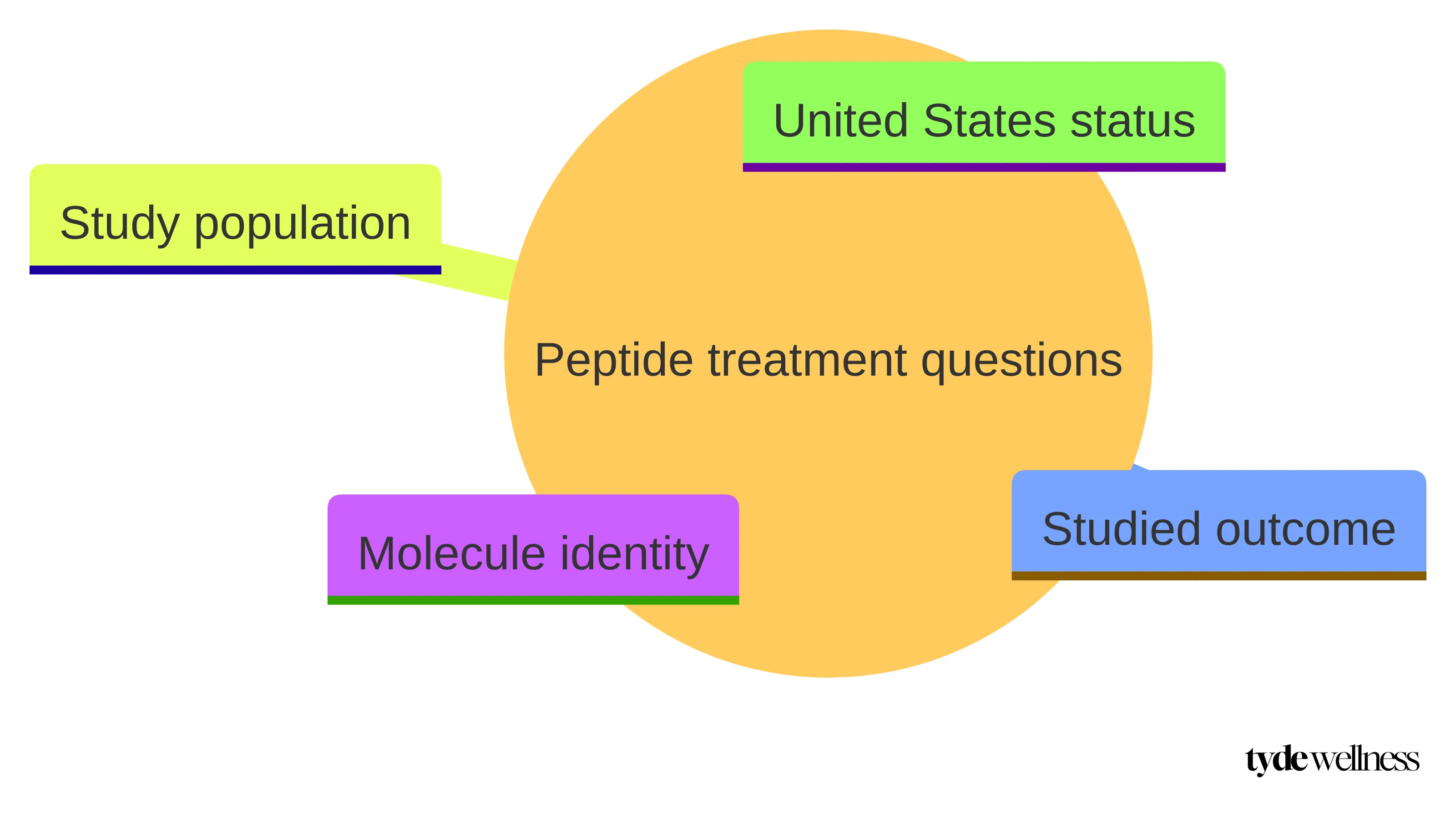
A practical way to read any peptide claim is to separate four questions: what the molecule is, what outcome it was studied for, who participated in the study, and what status applies in the United States. A physician can then compare those details with your overall health, weight history, medications, medical conditions, family history, goals, and potential risks. If a listing does not make the molecule or intended use clear, pause before treating its marketing language as medical information.
Read each claim through study context and follow-up
Read the examples below through four lenses: the molecule and intended use, the population and comparison in human studies, the measured outcome and follow-up period, and the date-stamped U.S. regulatory status. The Jackson Health System source was published on August 24, 2026, and regulatory classifications can change. These lenses help frame questions; they do not decide that any named option is appropriate for you.
| Group | Examples | What the cited material supports | What the label does not establish |
|---|---|---|---|
| FDA-approved peptide-based weight-loss medications identified by the cited U.S. source | Semaglutide, tirzepatide, and liraglutide | The source identifies these medicines as FDA-approved peptide-based weight-loss medications. | Approval does not determine whether a particular medicine fits your history, goals, or potential risks. |
| Peptides identified as not FDA-approved for weight loss | Retatrutide, cagrilintide, AOD-9604, and BPC-157 | The source states that these products are not FDA-approved for weight loss, even when promoted online. | Online promotion does not change that date-stamped regulatory distinction or establish effectiveness. |
| Products with limited human evidence for proposed benefits | BPC-157, CJC-1295, and GHK-Cu | The cited Harvard Health discussion says evidence for possible benefits in people is largely absent and that larger human trials are needed. | Test-tube or animal findings do not establish a weight-loss result or a safety profile for your use. |
Regulatory status and clinical evidence answer different questions, so read them in layers. The cited semaglutide trial reports a result for adults with obesity or overweight plus at least one weight-related condition and without diabetes; its comparison with placebo plus lifestyle intervention is part of that result. The STEP 1 extension adds a 52-week period after treatment stopped, following 68 weeks of initial treatment. The menopause review adds another boundary: greater weight loss with hormone therapy plus semaglutide than with semaglutide alone in postmenopausal women does not establish improvement in menopausal-transition symptoms or directly compare the treatments for those symptoms. Together, these examples support asking what was studied, what was measured, how long participants were followed, and which life-stage question remains unanswered. They do not turn a study result into a personal forecast or an eligibility determination.
A useful boundary is simple: do not treat semaglutide, tirzepatide, liraglutide, retatrutide, cagrilintide, AOD-9604, and BPC-157 as interchangeable because they appear in the same online conversation. Bring the exact name, proposed use, and source of the product to a physician. That step turns a broad trend into a specific clinical question.
What established GLP-1 evidence can and cannot tell you
Established GLP-1 evidence concerns defined medicines, defined study populations, and defined treatment plans—not peptides as a whole. The cited standards describe obesity medications as used alongside lifestyle changes, and they note that individual responses vary. A systematic review reports greater weight-loss efficacy for semaglutide and tirzepatide than for earlier GLP-1 receptor agonists such as liraglutide and exenatide. The same review describes tirzepatide as acting on both GLP-1 and GIP receptors.
GLP-1 evidence can help you understand what a particular medicine has been studied to do, but it cannot answer every personal question. The evidence does not turn a broad peptide product into a GLP-1 medicine, and it does not determine whether a treatment belongs in your plan. Your clinician still needs to consider your health history, current medications, medical conditions, goals, and potential risks before discussing a treatment choice.
Menopause-related questions require a separate distinction between weight change and menopause symptoms. The cited review reports greater weight loss in postmenopausal women receiving hormone therapy plus semaglutide than with semaglutide alone, but it does not establish that GLP-1 receptor agonists improve typical menopausal-transition symptoms or directly compare semaglutide with hormone therapy for those symptoms. The review also notes that only one included study used the MENQOL scale and calls for more research on the menopause experience.
That evidence supports a focused conversation, not a combined-treatment assumption. If you are considering a GLP-1 medicine during perimenopause or menopause, ask which goal is being addressed: weight management, a metabolic concern, menopause symptoms, or more than one concern. Ask what evidence applies to each goal separately. A clinician can then explain whether the proposed plan addresses the question you actually want answered.
Read weight-loss results as study evidence, not a personal forecast
The cited semaglutide trial studied adults with obesity or overweight plus at least one weight-related condition, without diabetes, who received semaglutide alongside lifestyle intervention. Participants had mean weight loss of 14.9% from baseline, which was 12.4 percentage points greater than placebo plus lifestyle intervention. Those details identify the medicine, comparison, intervention, population, and outcome. They do not describe every person who may search for peptide treatment.
The same trial reported that 86% of participants receiving semaglutide versus 32% receiving placebo lost at least 5% of baseline body weight. That percentage describes the share of participants who crossed a study threshold; it does not mean that 86% of future patients will have the same result or that the amount lost will be identical. The cited standards explicitly note that individual responses vary.
A study result becomes more useful when you read the conditions around it. Check the baseline population, whether participants had diabetes, the comparison group, the treatment duration, the role of lifestyle intervention, and the outcome being measured. A mean percentage, a threshold response, and a change in symptoms are different outcomes. Keep each result attached to the question it actually measured. For readers in different life stages, the study population is part of the result, not a footnote. The cited trial’s findings apply to the adults described in that trial and to its semaglutide-plus-lifestyle intervention; they do not by themselves answer a postpartum, breastfeeding, pregnancy-planning, perimenopause, or menopause question. If the match is incomplete, identify that gap for the clinician rather than filling it with a general peptide claim.
A clinician can help translate study context into a personal discussion without promising a result. Ask which parts of the available evidence resemble your health history, which parts do not, what lifestyle changes belong alongside medication, and how progress would be assessed. If a claim gives you a number without naming the population, comparison, duration, or outcome, treat the number as incomplete information.
Treat poorly studied peptides as an uncertainty question
BPC-157, CJC-1295, and GHK-Cu illustrate why human evidence deserves its own category. The cited Harvard Health discussion says possible benefits for products such as these are supported mainly by a limited number of test-tube and animal studies, while evidence in people is largely absent. The discussion calls for larger human trials before definitive claims about effectiveness or safety can be made. That boundary applies even when a product is described with technical language or surrounded by enthusiastic testimonials.
Uncertainty is not the same as proof that a product cannot work, but it does change what you can reasonably conclude. Without adequate human trials, you cannot use laboratory or animal findings as a personal weight-loss forecast, and you cannot assume that a proposed benefit has been evaluated alongside the risks relevant to you. The cited U.S. source also identifies BPC-157 as not FDA-approved for weight loss. Ask what is known before asking what is possible.
Several signals justify pausing for clarification before you pursue a product:
- The product name is vague, abbreviated, or different from the name on the proposed prescription or label.
- The marketing relies on animal or laboratory findings without identifying human trials.
- The page does not state the intended use or the product’s U.S. regulatory status.
- The language presents a fixed outcome instead of explaining uncertainty and individual variation.
- No clinician asks about your health history, medications, conditions, goals, or potential risks.
These signals do not tell you the final answer, but they tell you that the evidence-and-safety questions need attention first.
A clinician-guided discussion is the appropriate boundary for a poorly studied option. Bring the product name and the claims that attracted your attention, then ask which claims rest on human evidence and which remain hypothetical. A physician can also discuss nutrition, physical activity, behavioral changes, and other approaches instead of treating one uncertain product as the only path.
Keep menopause and postpartum context inside the safety review
Menopause context belongs in the treatment conversation because weight management and menopause symptoms are not the same clinical question. The cited review reports a weight-loss difference between postmenopausal women receiving hormone therapy plus semaglutide and those receiving semaglutide alone, while also stating that the research does not establish improvement in typical menopausal-transition symptoms. Ask your clinician to separate the goals rather than assuming that a weight-related result answers a symptom-related question.
Postpartum status, breastfeeding, pregnancy planning, and recent changes in health belong near the beginning of your evaluation. These details help a clinician interpret your goals, medical history, current medications, conditions, and potential risks. They also prevent a general weight-management discussion from being mistaken for an individualized decision. Do not use a general peptide description to decide whether a treatment fits your postpartum or breastfeeding circumstances.
Use life-stage questions that keep the conversation specific:
- Which goal is being addressed: weight management, a metabolic concern, menopause symptoms, or postpartum recovery?
- How do my current medications and health conditions affect the discussion?
- What information about breastfeeding, pregnancy planning, or postpartum recovery does the clinician need before considering an option?
- Which findings come from studies of participants with a similar life stage, and which findings come from a different population?
- What other nutrition, activity, behavioral, or clinical approaches should be considered?
The questions do not determine eligibility. They make the context visible before a treatment decision is made.
A postpartum or menopause label should not replace a health review. A physician can consider your overall circumstances and potential risks rather than assigning a treatment based on life stage alone. Bring the full context to that discussion, especially if a product page presents a peptide as a general answer for hormonal weight changes.
Include maintenance and uncertainty beyond the first result
Maintenance belongs in the first treatment conversation because the cited STEP 1 extension followed participants for 52 weeks after they stopped once-weekly semaglutide 2.4 mg or placebo, following 68 weeks of initial treatment. That follow-up design shows why a starting decision has a later phase: you need to understand what happens after the initial study period and after treatment changes. The design alone does not predict your course or establish that every patient will respond in the same way.
A systematic review examined weight regain after weight-management medication ended. The review found no evidence that the intensity of behavioral support during medication treatment changed the rate of post-treatment weight regain. In analyses limited to incretin mimetics, greater behavioral support was associated with 6.7 kg more weight loss during treatment and a 0.3 kg faster monthly rate of regain afterward; after adjustment for initial weight loss, the rate of regain did not differ by support intensity.
Ask maintenance questions before you start, not only after an early result:
- What treatment period is being discussed, and what decisions might follow it?
- How will progress and changes be assessed over time?
- What is the plan if the treatment is paused, stopped, or no longer suitable?
- Which lifestyle changes are intended to continue regardless of medication status?
- What uncertainty remains about maintaining a result for someone with my circumstances?
These questions do not promise a maintenance outcome. They make the longer time horizon part of the decision.
A first result should not be the only measure of a treatment decision. The standards describe obesity medications alongside lifestyle changes, while the STEP 1 extension demonstrates that follow-up after initial treatment was a defined research question. A plan that explains only the first outcome leaves you without a clear framework for later decisions. Ask for that framework before you treat an early response as the whole story.
Turn study findings into clinician questions
Use the checklist after reading a study claim, so the conversation tests applicability and follow-up rather than just collecting product names. The cited recommendation is to discuss options with a physician who can review overall health, weight history, medications, medical conditions, family history, goals, potential risks, nutrition, physical activity, behavioral changes, and other approaches. Add the study population, comparison, measured outcome, treatment period, and post-treatment follow-up to that discussion.
- What exact molecule and intended use are being discussed? Name the product and the outcome it is supposed to address.
- Who was studied, and what did the comparison group receive? Ask whether the participants and comparator resemble the question you are bringing to the appointment.
- What did the study measure, and for how long? Separate a reported weight outcome from claims about symptoms, health, or long-term maintenance.
- What is known after treatment changes or stops? Ask whether follow-up exists and how it affects interpretation of the initial result.
- What does the evidence say about my life-stage question? Discuss postpartum recovery, breastfeeding, pregnancy planning, perimenopause, or menopause without assuming that a weight result answers symptom or eligibility questions.
- What is the date-stamped U.S. regulatory status for this exact product and use? Ask what the cited status does and does not establish.
- How do my health history and current treatment affect the discussion? Include medications, medical conditions, family history, weight history, goals, and potential risks.
- What belongs alongside medication, and how will follow-up work? Discuss nutrition, physical activity, behavioral changes, other approaches, and the questions to revisit over time.
A product deserves more clarification before you proceed if you cannot get a clear active ingredient, intended use, human evidence, regulatory status, or clinician review. The same boundary applies when marketing turns animal or laboratory findings into a definite human outcome. Pause, gather the missing information, and ask a qualified clinician to weigh the option against your circumstances.
A written list of your medications, medical conditions, family history, goals, life-stage details, and questions can make the appointment more specific. Bring the product name and any claims you have seen so the clinician can address the exact option rather than a broad category. Leave the conversation knowing which questions were answered, which remain uncertain, and what discussion should happen next. Consider leaving with a short decision record: the exact active ingredient, intended use, date and source of the regulatory information, the human evidence that was reviewed, the questions that remain unanswered, and the follow-up or treatment-change issues that need to be revisited. This record is not a prescription or eligibility decision. It keeps product identity, evidence, uncertainty, and personal context separate when you review information later. If a product cannot be described clearly enough to record those basics, pause and seek clarification before treating the option as established care.
Make the decision about evaluation, not internet claims
Your next decision is whether a specific option merits clinician-guided evaluation after its evidence, regulatory status, life-stage context, potential risks, and maintenance questions have been examined. A qualified clinician decides individual suitability; a general article cannot make that determination for you.
Bring the exact product name and your questions to that evaluation. A clear discussion should address your health history, medications, conditions, goals, postpartum or menopause context, available human evidence, and alternatives that may belong in a broader weight-management plan.
What should you ask before discussing peptide-based weight loss?
What peptides are not FDA-approved for weight loss?
Peptides such as retatrutide, cagrilintide, AOD-9604, and BPC-157 are not FDA-approved for weight loss, even if they are promoted online.
How do GLP-1 medications differ from other peptides?
GLP-1 medications are a type of peptide that mimics a naturally occurring hormone involved in blood sugar regulation and appetite control. Not all peptides have the same established evidence or regulatory approval as GLP-1 medications.
What should I consider before pursuing peptide-based weight-loss treatment?
Before pursuing peptide-based treatment, consider discussing your overall health, weight history, medications, medical conditions, and potential risks with a qualified clinician. It’s also important to understand the specific peptide’s evidence, regulatory status, and intended use.
What questions should I ask my clinician about peptide options?
Ask your clinician about the exact active ingredient and intended use, the U.S. regulatory status, supporting human studies, how your health history affects the discussion, and what other approaches should be considered alongside medication.
What are the potential risks associated with using poorly studied peptides?
Poorly studied peptides may lack sufficient human evidence for safety and efficacy. It’s important to approach these options with caution and seek clarification from a clinician regarding their use and potential risks.
How can I prepare for a discussion about peptide-based weight loss with my clinician?
Prepare by compiling a list of your medications, medical conditions, family history, goals, and specific questions about the peptide options you are considering. This will help facilitate a focused and informative discussion.

