

What GLP-1 Treatment Actually Means
Treatment in this category may use medications acting on pathways related to an incretin hormone called glucagon-like peptide-1. The hormone is involved in glucose metabolism and appetite regulation, while GLP-1 receptor agonists can influence insulin secretion, insulin sensitivity, and gastric emptying. These medications are used to treat diabetes and support weight-related health conditions. They also help regulate appetite, blood sugar, and metabolism.
That description explains a treatment category, not your personal plan. A medication search becomes a health decision when you consider what you want to address, which health circumstances may affect care, how an option is taken, and which trade-offs you would need to discuss. The useful question is not simply whether these medications are widely discussed. It is whether a clinician-guided approach deserves a careful conversation about your goals and circumstances.
This care can involve more than a medication name. The decision may include the reason for treatment, the formulation and schedule, potential effects on weight-related health conditions, possible side effects, medication interactions, cost, and life-stage considerations. A clinical review describes different formulations, routes of administration, and dosing flexibility, while a clinical guideline advises discussing those practical factors with a healthcare professional.
Use the rest of this guide to turn a broad search into a focused set of questions. You do not need to select a medication before you understand the circumstances that should shape the conversation.
Turn a Medication Search Into a Care Decision
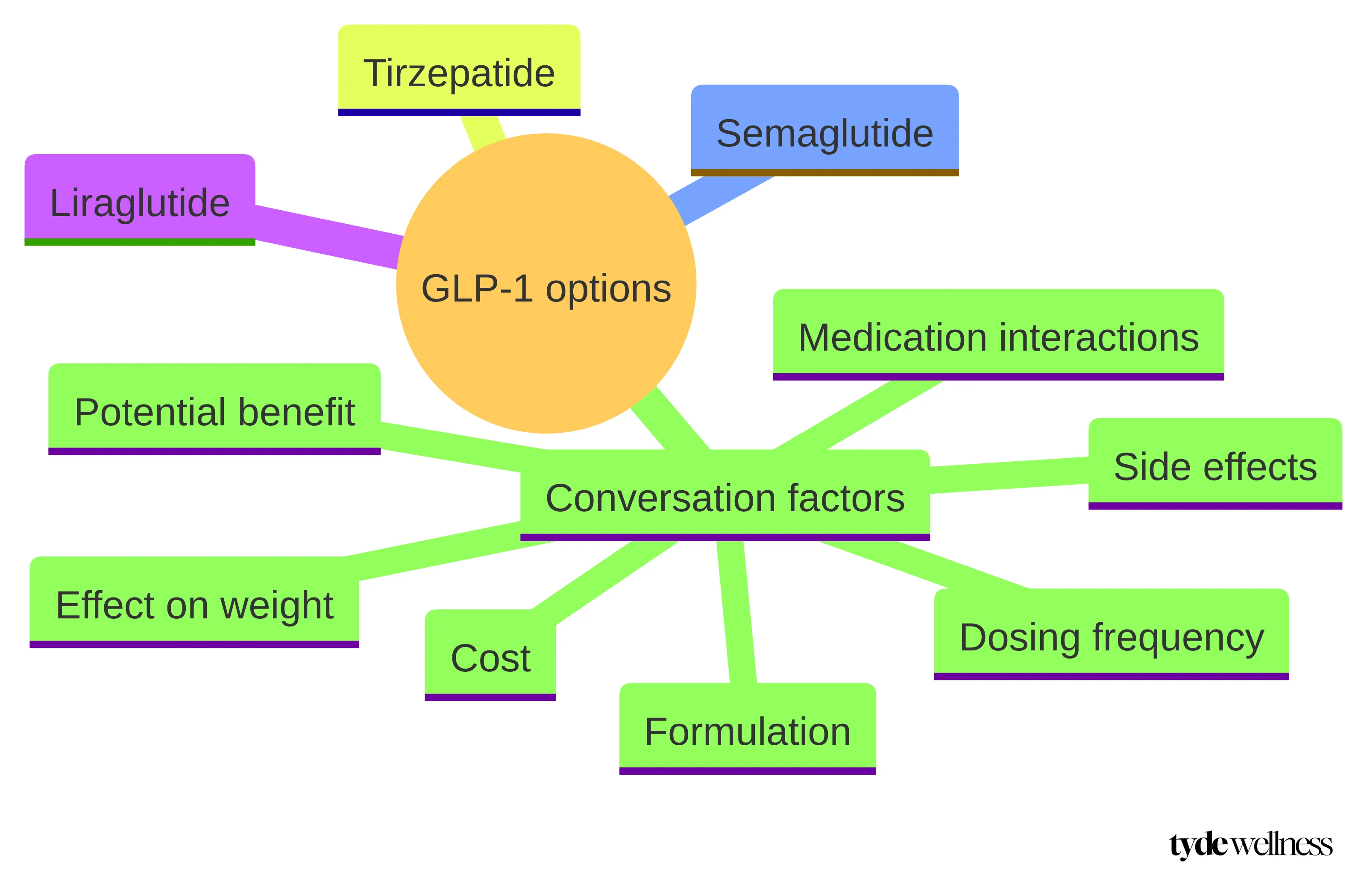
A clinician-guided GLP-1 decision starts with the outcome and circumstances you want to discuss, not with a single product name. A Canadian clinical guideline advises discussing potential benefit for obesity-related health conditions, effects on weight, side effects, formulation, dosing frequency, medication interactions, and cost with a healthcare professional. A personalized weight-management plan may also consider your medical history, lifestyle, hormonal changes, and personal preferences, including during postpartum recovery and menopause.
Organize the conversation around four questions:
- What health or daily-life concern are you hoping to address?
- Which treatment characteristics matter to you, such as route, schedule, potential effects, side effects, or cost?
- What medical history, medications, life-stage circumstances, or hormonal changes should be part of the review?
- What would help you judge progress by overall health and well-being rather than by a single scale reading?
This structure connects the decision to your priorities. It also prevents a general description of medication from becoming an individualized recommendation.
Life-stage context can change which questions deserve attention first. Postpartum recovery, menopause, hormonal changes, existing health conditions, daily routines, and personal preferences may all affect the discussion. If pregnancy planning or breastfeeding applies to you, put that information at the beginning rather than treating it as a later detail.
Start by describing your circumstances and priorities. Then ask how those factors shape the available discussion. A care conversation should account for the realities of your schedule and health history without assuming that one explanation or one medication fits every situation.
Compare GLP-1 Options by the Factors That Matter
These three names should be treated as separate entries in the Canadian guideline, not as interchangeable treatment plans. The available information does not map liraglutide, semaglutide, or tirzepatide to a U.S.-specific route, schedule, efficacy profile, or side-effect pattern. The separate review describes broader differences among single, dual, and triple receptor agonists, including efficacy, routes of administration, and dosing flexibility, but it does not assign those distinctions to these three names. The usable next step is therefore to separate the facts established by the list from the option-specific questions that require U.S. clinical review. A Canadian clinical guideline lists liraglutide, semaglutide, and tirzepatide among medications approved by Health Canada for long-term obesity management. That Canadian list does not establish U.S. approval, U.S. eligibility, or suitability for your circumstances. A separate review discusses single, dual, and triple receptor agonists and describes differences in efficacy, routes of administration, and dosing flexibility.
The table below shows how to use those names as conversation starters rather than as a ranking. It keeps the Canadian regulatory context separate from the questions that require U.S. clinical review.
A useful distinction is therefore between a shared regulatory listing and an interchangeable treatment plan. The Canadian guideline places liraglutide, semaglutide, and tirzepatide in the same list for long-term obesity management, but the available information does not establish that they have the same formulation, route, dosing frequency, potential effects, side effects, interactions, or cost. The separate review’s single-, dual-, and triple-receptor language offers a way to ask how an option is categorized, but it does not support assigning one of those categories to a named medication here. In a U.S. clinical conversation, ask the clinician to identify the relevant formulation and treatment context, then explain which differences matter given your health history and priorities.
If you encounter one of these names in an advertisement or online discussion, treat it as a prompt for questions rather than a selection. Ask what the name refers to, how the option would be taken, what practical schedule it involves, and which potential benefits and unwanted effects deserve attention. That approach preserves a meaningful distinction—options may differ in how they are formulated and used—without turning incomplete comparison information into a recommendation.
| Medication name | What the Canadian guideline establishes | What still requires clinical discussion in the United States |
|---|---|---|
| Liraglutide | Listed among medications approved by Health Canada for long-term obesity management | Whether it fits your health circumstances, including potential benefits, side effects, interactions, route, schedule, and cost |
| Semaglutide | Listed among medications approved by Health Canada for long-term obesity management | Whether it fits your health circumstances, including potential benefits, side effects, interactions, route, schedule, and cost |
| Tirzepatide | Listed among medications approved by Health Canada for long-term obesity management | Whether it fits your health circumstances, including potential benefits, side effects, interactions, route, schedule, and cost |
A comparison framework gives you a consistent way to discuss any named option:
- Purpose and health context: Ask which weight-related or metabolic concerns the option is intended to address and which potential health benefits are relevant to you.
- Formulation and route: Ask how it is administered and whether that format fits your routine. The guideline specifically identifies injection versus pill as a factor to discuss.
- Dosing frequency: Ask how often it is taken and what that schedule would require from you. General information cannot determine the schedule for your care.
- Potential effects and side effects: Unwanted effects and medication interactions are general decision considerations, but the approved material here does not provide a medication-specific side-effect list or a way to rank those concerns across the named options. Ask the clinician to connect the option under discussion with your medical history, current medications, and the unwanted effects that should be discussed.
- Medication interactions: Share the medications and treatments you use so possible interactions can be considered.
- Cost: Ask how treatment costs fit your circumstances and which financial factors belong in the decision.
This approach lets you compare options without ranking them. The useful comparison is the one that connects a treatment’s characteristics to your health context and practical needs.
For a more usable safety comparison, separate the discussion into three checks. First, ask about potential side effects for the option under discussion and how those concerns relate to your medical history; the material provided here does not support importing a side-effect list from one medication to another. Second, review medication interactions by giving the clinician a current list of medications and treatments. The question is not simply whether an interaction exists in the abstract, but which interaction considerations belong in your own review. Third, assess practical fit: route, dosing frequency, cost, lifestyle, and personal preferences can affect whether a plan is workable for you.
Pregnancy planning and breastfeeding should be stated before this comparison is treated as complete. They are not just additional preferences; they change which questions need to be answered and who should be involved in the discussion. If either circumstance applies, bring it into the review with your obstetrician-gynecologist and the clinician discussing weight-management care. The goal is not to create a ranking from general information. It is to leave the conversation knowing which option-specific facts, safety questions, and practical trade-offs still need an answer.
Understand Potential Benefits Without Expecting a Guaranteed Result
Potential benefits of GLP-1 medication should be read as evidence about a treatment category, not as a forecast for you. The cited review states that weight loss of 5–15% can improve many obesity-related complications. The same review states that pharmacotherapy can help people with obesity achieve and maintain weight loss and may reduce the risk of obesity-related complications. Those statements describe possible health effects in the context of obesity management; they do not promise a particular amount of weight loss or a particular timeline for you.
A Canadian clinical guideline also says that obesity-management goals should include improving health and outcomes that matter to you. That broader frame gives you a better basis for discussion than a number alone. Ask which health, function, energy, or daily-life outcomes should be considered alongside weight, while recognizing that the answer depends on your circumstances.
Published ranges describe groups, while your decision concerns your own health context. General information cannot tell you whether you would experience the result described in a review. It can help you ask whether the possible benefits relate to your goals and whether the trade-offs deserve professional review.
Keep two expectations separate: medication may be part of a plan for weight-related health, and no general source can guarantee your outcome. Focus the conversation on health and well-being rather than setting a specific weight as the only measure of success. A clinician can help connect the available evidence to the factors that apply to you.
Make Safety Review Part of the Choice
Safety review belongs at the beginning of a GLP-1 medication decision because the relevant questions depend on the option and your circumstances. A Canadian guideline identifies potential side effects, medication interactions, formulation, dosing frequency, cost, potential benefit for health conditions, and effects on weight as factors to discuss with a healthcare professional. A personalized plan may also take medical history, lifestyle, hormonal changes, and personal preferences into account.
Prepare information that can change the conversation:
- The health concerns you want to address and the outcomes that matter to you.
- Your current medications and treatments, so possible interactions can be discussed.
- Your relevant medical history and any life-stage circumstances that may affect the plan.
- Your questions about side effects, formulation, schedule, and cost.
- Any pregnancy planning or breastfeeding context that applies to you.
These details do not determine a treatment choice by themselves. They give the clinician the context needed to discuss available options and their conditions.
One way to keep the safety review concrete is to distinguish a question from an answer. “What side effects and interactions should I consider with this option?” is a supported question; “This option is safe for me” is a conclusion that requires clinical review. The same boundary applies to formulation, dosing frequency, and cost: a general comparison can identify topics, but it cannot resolve how they apply to your medical history or other treatments.
Before the discussion, note the medication and treatment names you use and the life-stage details that may affect the review. You can then ask the clinician to connect those details to the option being discussed. This preparation makes the appointment more focused while preserving the clinician’s role in interpreting safety and suitability.
GLP-1 guidance can change as new studies are published, so an older online explanation may not answer a current treatment question. The American College of Obstetricians and Gynecologists advises that decisions about these medications should be made with a health care professional and should focus on overall health and well-being rather than a specific weight. Use general information to identify what you need to ask, then keep medication-specific decisions inside the clinical conversation.
Put Pregnancy Planning and Breastfeeding First
Pregnancy planning changes the order of your medication questions. The American College of Obstetricians and Gynecologists states that GLP-1 medications are not recommended during pregnancy. If you are planning a pregnancy, discuss with your obstetrician-gynecologist when to stop taking a GLP-1 medication. A general article cannot set a stopping date or tell you to make a medication change.
Tell the clinician about pregnancy plans before discussing a treatment schedule. That information can affect how the conversation is framed and which questions need an answer first. Put pregnancy planning at the top of your medication review.
Breastfeeding requires its own discussion after delivery. The American College of Obstetricians and Gynecologists states that if you are breastfeeding, you can discuss with your obstetrician-gynecologist whether a GLP-1 medication may be appropriate for your postpartum care plan. That discussion should account for your postpartum circumstances rather than treating breastfeeding as a minor qualification.
If you are breastfeeding, tell your obstetrician-gynecologist before pursuing medication and ask whether it belongs in your postpartum care plan. If you are planning pregnancy, take that information to your obstetrician-gynecologist before starting or changing treatment.
Bring Postpartum, Perimenopause, and Menopause Context to the Conversation
Postpartum recovery, perimenopause, and menopause are context questions, not automatic explanations for every change in weight or health. A personalized weight-management plan may consider medical history, lifestyle, hormonal changes, and personal preferences, including during postpartum recovery and menopause. That means your life stage belongs in the clinical discussion alongside your goals and routine.
Describe the circumstances that may affect your care:
- Whether you are in postpartum recovery and whether breastfeeding applies to you.
- Whether you are experiencing perimenopause or menopause-related changes that you want to discuss.
- Which changes in appetite, energy, routine, or weight matter most to you, without assuming a single cause.
- Which medical history, medications, lifestyle factors, and personal preferences should shape the conversation.
This information helps keep the discussion specific to your situation. It does not establish that medication is appropriate or identify an option for you.
Life-stage context also affects the outcomes you may want to prioritize. The American College of Obstetricians and Gynecologists advises focusing on overall health and well-being rather than a specific weight, while personalized-program guidance includes lifestyle, hormonal changes, and personal preferences among the factors that may be considered. Ask how your goals fit into that wider picture.
A treatment conversation should leave room for practical routines and health priorities, not only a scale target. If your schedule is shaped by infant care, work, changing energy, or symptoms associated with hormonal transitions, explain that directly so the clinician can address the circumstances with you.
Recognize What General GLP-1 Information Cannot Decide
General GLP-1 information can explain the treatment category and help you prepare questions, but it cannot decide whether care fits your circumstances. It cannot select a medication, determine a dose, establish a schedule, or predict your individual result. It also cannot weigh your medical history, other medications, life stage, potential side effects, interactions, formulation preferences, and cost as a single clinical decision.
A published weight-loss range cannot become your personal target simply because it appears in a review. A medication list from another country cannot establish what is approved or appropriate in the United States. A broad description of postpartum, perimenopause, or menopause care cannot replace a discussion of your own health context. Keep those boundaries clear when you evaluate information online.
Online information has three practical uses in your decision:
- Learn the basic role of GLP-1 medications so unfamiliar terms are easier to understand.
- Identify the factors that deserve discussion, including potential benefits, side effects, interactions, formulation, schedule, cost, pregnancy planning, and breastfeeding.
- Decide whether your questions justify exploring a clinician-guided evaluation.
That is enough to move from a broad search to a prepared conversation. It is not a basis for self-selecting a medication or changing treatment on your own.
Prepare Questions for a Qualified Clinician
A clinician appointment becomes more useful when your questions connect treatment factors to your own goals. Bring this checklist and mark the questions that match your situation:
- Which health outcomes should we prioritize alongside weight?
- What potential benefits are relevant to my health circumstances?
- How do available options differ in formulation, route, dosing frequency, potential effects, side effects, medication interactions, and cost?
- Which parts of my medical history and current medication list should affect the discussion?
- How should my lifestyle and personal preferences shape the plan?
- How do postpartum recovery, perimenopause, or menopause change the questions we should address?
- If I am planning a pregnancy, when should I discuss stopping a medication with my obstetrician-gynecologist?
- If I am breastfeeding, could a medication be part of my postpartum care plan?
- How should we define progress through overall health and well-being instead of a specific weight?
The Canadian guideline supports discussing potential health benefits, weight effects, side effects, formulation, dosing frequency, interactions, and cost. Personalized-program guidance supports including medical history, lifestyle, hormonal changes, and personal preferences. The American College of Obstetricians and Gynecologists supports the pregnancy, breastfeeding, and overall-well-being questions.
Preparation does not need to produce a treatment answer before the appointment. Write down the outcome you want to address, the parts of daily life that may affect your ability to follow a schedule, the medications and treatments you use, and the life-stage details that may change the discussion. If cost or formulation matters to you, say so directly; both belong among the treatment considerations identified in clinical guidance.
You can also separate questions into three groups: what you hope to improve, what conditions or treatments may affect the decision, and what practical requirements you can manage. That organization helps keep the conversation focused without turning your notes into a self-assessment. Leave the appointment with a clearer set of conditions and questions, not with a promise about a particular result.
Take an Evaluation-Based Next Step
At Tyde Wellness, we offer personalized medical weight-loss services and real-time messaging with our care team. A qualified clinician must decide whether treatment is suitable for your circumstances, with the discussion focused on your overall health and well-being. Bring the questions above into that evaluation and discuss your goals and relevant health context.
Questions to Ask Before Exploring GLP-1 Care
What is GLP-1 treatment and how does it work?
GLP-1 treatment involves medications that act on glucagon-like peptide-1, an incretin hormone that helps regulate glucose metabolism and appetite. These medications can influence insulin secretion, insulin sensitivity, and gastric emptying, making them useful for treating diabetes and supporting weight-related health conditions.
What should I discuss with a healthcare professional when considering GLP-1 medications?
When considering GLP-1 medications, discuss potential benefits for your health conditions, effects on weight, side effects, formulation, dosing frequency, medication interactions, and cost. It’s also important to consider your medical history, lifestyle, and any hormonal changes.
Are there specific considerations for women who are pregnant or breastfeeding regarding GLP-1 medications?
These medications are not recommended during pregnancy. Women planning a pregnancy should consult their healthcare provider about when to stop taking these medications. After delivery, breastfeeding women can discuss with their healthcare provider whether GLP-1 medications may be appropriate for their postpartum care.
How can I prepare for a conversation with a clinician about GLP-1 treatment?
Prepare by identifying your health concerns, the outcomes you hope to achieve, your current medications, and any relevant medical history. Bring questions about potential benefits, side effects, and how your lifestyle may affect treatment.
What factors should I consider when comparing different GLP-1 medications?
Consider the purpose and health context, formulation and route of administration, dosing frequency, potential effects and side effects, medication interactions, and cost when comparing GLP-1 medications.

