

Start with what the treatment can—and cannot—answer
GLP-1 treatment refers to medication that works through the effects of GLP-1, an insulin-regulating hormone, including signaling pathways in the body and brain. Those effects can influence digestion and fullness, which helps explain why these medicines are discussed in weight management. For people with obesity, weight-management medication can support weight loss and its maintenance.
Perimenopause and menopause-related weight changes add personal context, not an automatic treatment decision. A qualified clinician needs to assess your health history, medications, goals, possible benefits, side effects, interactions, dosing frequency, administration method, and cost before you pursue treatment. A quiz can help you decide whether to start a conversation, but it cannot replace that assessment.
This guide follows a practical path:
- understand what these medicines do in broad terms;
- connect appetite and digestion changes with everyday eating and weight management;
- separate general eligibility language from an individual clinical decision; and
- prepare questions for a clinician or online care team.
The useful question is not whether this treatment is right for every woman. The useful question is whether you have enough context to decide whether a qualified clinical evaluation is worth exploring.
GLP-1 in plain language: a signal the body and brain respond to
GLP-1 is an insulin-regulating hormone whose effects reach signaling pathways in the body and brain. Receptor agonists work through those effects rather than functioning as a generic appetite product or a stand-alone lifestyle plan. That distinction matters because the treatment is a medical intervention with a mechanism, potential benefits, possible side effects, and decisions about whether it fits your circumstances.
The term can refer to the hormone, the receptor pathway, or medicines that act through that pathway. In a weight-management conversation, you will often hear it used as shorthand for medicines in this class. Asking which specific medication is being discussed prevents the conversation from becoming too vague.
A plain-language explanation should answer three questions:
- What medication or medication class is being considered?
- What purpose would the treatment serve in your care plan?
- How would a clinician assess its potential benefits, risks, and fit?
The mechanism explains why appetite and eating may change, but it does not tell you whether treatment is appropriate. Your health history and clinical assessment still determine the next step.
One useful way to keep the mechanism in perspective is to separate three layers of the conversation. The first is the biological pathway: GLP-1-related signaling can affect processes involving digestion, fullness, and the body and brain. The second is the day-to-day experience: a person may notice changes in appetite, portion comfort, or eating patterns, but those experiences are not identical for everyone. The third is the clinical decision: a reported change can give a clinician useful information, yet it does not establish eligibility, prove that a medication is suitable, or determine a dose.
Keeping these layers separate prevents a common misunderstanding. Knowing how a medicine works is not the same as knowing what it will do for you, and noticing an appetite change is not the same as confirming a health outcome. It also explains why the name of the specific medication matters. A clinician can connect the medication under discussion with your history, goals, other treatments, possible risks, and follow-up needs instead of treating the word GLP-1 as a complete treatment description.
How GLP-1 treatment may change appetite and digestion
GLP-1 medications can slow digestion, so you may feel full faster and find that large, heavy meals cause discomfort. This change can affect how much food feels comfortable at one time, how you plan meals, and how you notice hunger and fullness. It does not mean that every person experiences the same response or that eating less automatically meets your nutrition needs.
The experience can be practical as well as physiological. A meal that once felt ordinary may feel too large, while a smaller portion may be enough for comfort. Appetite, taste, digestion, hydration, and energy can all become useful topics for a treatment conversation. If eating becomes difficult or hydration becomes hard to maintain, bring that information to the care team rather than trying to manage the treatment alone.
These effects are not a promise of weight loss. They explain one pathway through which medication may affect eating behavior and intake. A clinician still needs to decide whether the potential benefit outweighs the relevant risks for you.
Everyday eating during treatment may require attention to portion size, food density, hydration, and tolerance. Selected nutrition guidance recommends portions suited to your appetite, nutrient-dense foods, adequate hydration, and electrolytes; it says fiber-rich foods may help when tolerated and that too much fat can trigger nausea. Those are general considerations, not an individualized meal plan. Ask a qualified professional how they apply to your medication, health history, and eating pattern.
What that connection may mean for weight management
Weight management is the broader question that connects medication, appetite, eating patterns, activity, health conditions, and long-term follow-up. For people with obesity, a review of GLP-1 receptor agonists explains that pharmacotherapy can help support weight loss and maintenance and may reduce the risk of obesity-related complications. That population-level finding does not predict your outcome, and it does not establish that you have obesity.
Medication may make some parts of eating easier to manage, but medication is not a substitute for understanding your goals or planning for ongoing care. You may want to ask whether the purpose of treatment is weight reduction, maintenance, improvement in a weight-related health concern, or a combination of goals. Naming the goal helps you and the clinician judge whether the plan is working in a meaningful way.
A useful weight-management discussion includes more than a scale reading:
- What health outcome matters to you?
- What changes in appetite, eating, movement, sleep, or energy would be useful to track?
- What side effects or practical barriers could make the plan difficult to continue?
- What would happen if the medication is ineffective, poorly tolerated, or no longer available?
These questions keep the treatment in context. They also reduce the chance that a general claim about weight loss will be mistaken for a personal forecast.
Another useful distinction is the difference between a possible treatment response and treatment fit. A response describes information that may emerge during care, such as changes in appetite, eating, weight, or tolerability. Fit is the broader clinical judgment about whether the medication, its potential benefits and risks, its administration, its cost, and its follow-up make sense for a particular person. A response cannot answer the fit question by itself.
You can organize a consultation around four checkpoints: the purpose of treatment, the outcomes that would matter to you, the information that will be reviewed during follow-up, and the plan if the approach is ineffective or difficult to tolerate. This structure turns a broad interest in weight loss into a clearer discussion without turning the checklist into an eligibility test. It also makes maintenance part of the conversation from the beginning. If medication is being considered to support both weight loss and maintenance, ask how the clinician would discuss longer-term goals rather than assuming that reaching an initial milestone ends the care decision.
Keep perimenopause and menopause in clinical context
Perimenopause and menopause are important health context to bring into a weight-management conversation, but a life stage alone cannot determine whether GLP-1 treatment is appropriate. Tell the clinician about the changes you are noticing, when they began, the treatments or supplements you use, and the outcomes you want to address. That information can help the clinician consider your situation as a whole rather than treating a weight measurement in isolation.
Perimenopause or menopause may also shape the questions you bring to care. You can ask how the proposed plan relates to your current symptoms, other hormone-related care, nutrition, activity, and goals. Avoid assuming that every midlife weight change has one cause or one treatment. Use your life-stage context to improve the clinical conversation, not to self-diagnose or self-prescribe.
Medication works within a broader weight-management plan
Weight-management medication is generally considered alongside health-behavior changes rather than as an isolated intervention. A selected Canadian guideline describes obesity medication as often being used with health-behavior changes and, when appropriate, psychological interventions. The Endocrine Society statement says diet, exercise, and behavior change should be part of obesity-management approaches.
That principle does not mean medication has failed if you still need support with food, movement, sleep, stress, or routines. It means the plan should account for the parts of health that medication does not independently address. Your clinician can help define which changes are realistic, which outcomes matter, and how to adjust the plan if your circumstances change.
A broader plan may include:
- nutrition guidance that accounts for appetite and digestive tolerance;
- physical activity suited to your current ability and goals;
- discussion of other medicines, conditions, and possible interactions;
- follow-up for effectiveness, side effects, and continuation; and
- support for the practical demands of work, caregiving, travel, or changing routines.
The treatment plan should make these pieces understandable. Ask who is responsible for each part, how you will communicate between appointments, and how progress will be assessed. A medication choice without a plan for follow-up leaves important decisions unanswered.
Support everyday eating when appetite or digestion changes
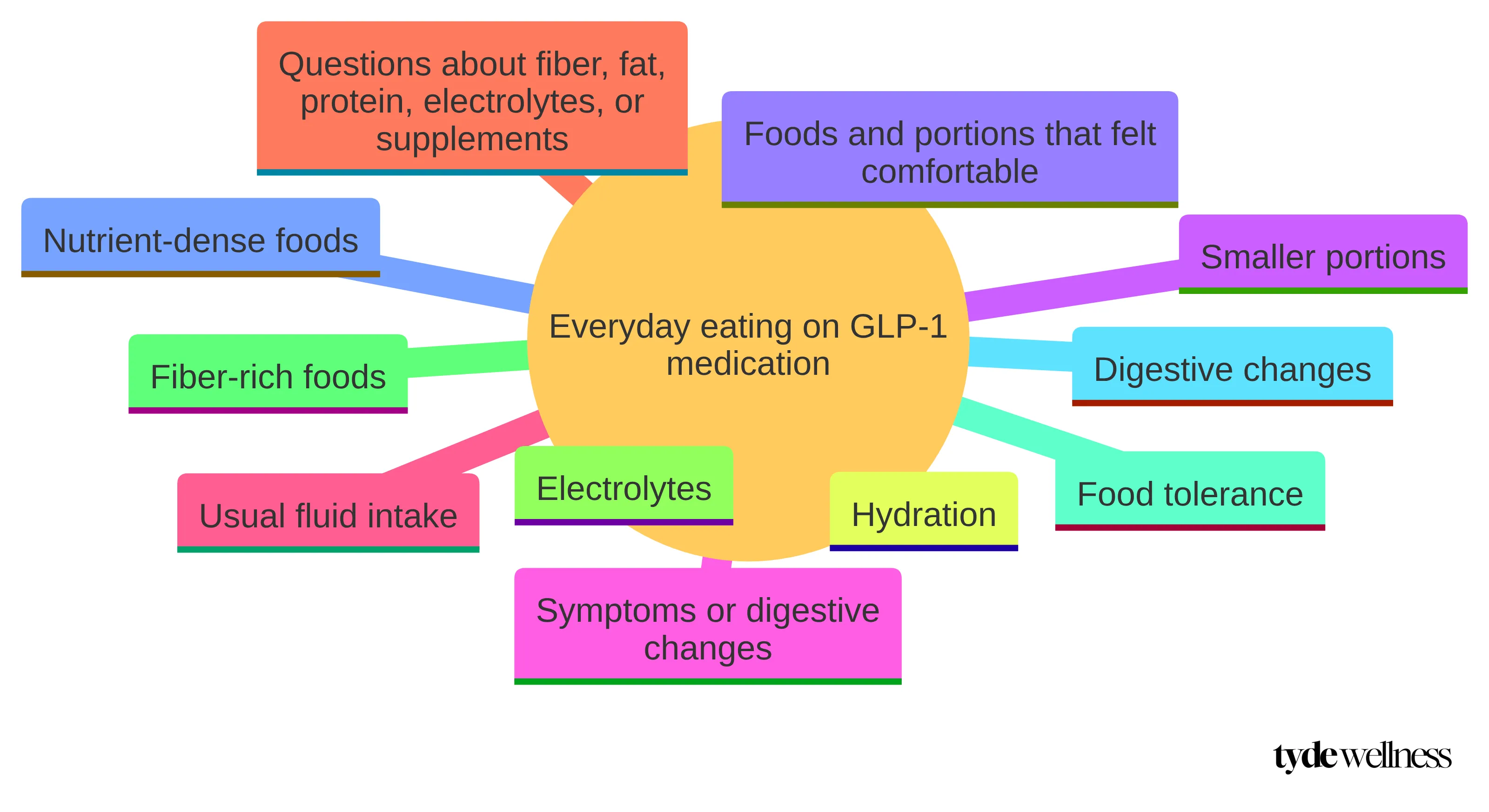
Everyday eating on GLP-1 medication may call for smaller portions and attention to how your body tolerates food. Selected nutrition guidance recommends portions that match appetite while still meeting nutrition needs, nutrient-dense foods, hydration, and electrolytes when you are eating less overall. It also says fiber-rich foods may be used when tolerated and that too much fat can trigger nausea.
These suggestions are practical prompts, not a prescription for your meals. Your clinician or qualified nutrition professional may need to adapt them for your medical history, medication, eating pattern, allergies, activity, or other needs. You can make the conversation more useful by recording what feels comfortable, what causes discomfort, how much you are drinking, and whether meals are becoming difficult to manage.
A simple preparation list can include:
- foods and portions that have felt comfortable;
- symptoms or digestive changes and when they occur;
- your usual fluid intake and any concern about dehydration;
- questions about fiber, fat, protein, electrolytes, or supplements; and
- the times when work, caregiving, travel, or fatigue make regular eating harder.
The purpose of this list is immediate: use it to describe your experience clearly during follow-up. It is not a promise that a particular food pattern will prevent side effects or produce a specific result. If your appetite changes sharply, eating becomes distressing, or hydration becomes difficult, contact the care team for guidance.
GLP-1 treatment requires attention to more than weight change. A selected review recommends ongoing monitoring for disordered eating, food aversion, dehydration, and broader health effects. Bring those concerns to a qualified clinician instead of changing medication, dose, or eating strategy on your own.
Make clinician assessment the decision boundary
Clinician assessment is the boundary between learning about GLP-1 treatment and deciding whether it belongs in your care. A qualified healthcare professional should discuss eligibility, potential benefits and side effects, medication interactions, dosing frequency, administration method, and cost with you. Those factors cannot be resolved by a general article, a search result, or a short questionnaire.
The assessment should start with your circumstances rather than with a preferred medication. Prepare a complete medication and supplement list, relevant health history, previous weight-management experiences, allergies, current symptoms, pregnancy or pregnancy-planning questions when applicable, and the outcomes you want to discuss. The clinician can then consider whether treatment is suitable, what alternatives may exist, and what follow-up would be needed.
Medication choice and dosing are clinical decisions. Do not select a dose from another person’s experience, change an instruction because progress feels slow, or assume that a branded medication or a compounded option has the same considerations. Ask the clinician to explain the specific medication, the reason it is being considered, how it will be monitored, and what would lead to a change in the plan.
A useful assessment should leave you with a clear next step, not simply a yes-or-no impression. You should know what is being evaluated, which questions remain open, how communication works, and when follow-up occurs.
Treat eligibility language as a starting point, not a verdict
Eligibility language is a starting point because different sources describe criteria in different contexts. That is a general guideline statement in a U.S. context, not an individualized determination.
At Tyde Wellness, a practitioner clarifies GLP-1 eligibility criteria and their implications. That is Tyde Wellness’s described eligibility context, not a conclusion about your eligibility.
The difference between general guidance and a practice’s described criteria is worth discussing rather than resolving through guesswork. Ask:
- Which criteria apply to the specific medication being considered?
- Which health conditions, medications, or circumstances affect the assessment?
- What information does the clinician need before making a decision?
- What happens if you do not meet the stated criteria or the treatment is not appropriate?
A general eligibility criterion can help organize a conversation, but it cannot diagnose you, explain every health concern, or determine the right treatment by itself.
Build monitoring into any treatment decision
A selected medical review notes that questions remain about the long-term safety and efficacy of GLP-1 receptor agonists, especially when weight loss is not monitored.
Ask the clinician to explain what will be tracked and how often you will communicate. The follow-up conversation should identify which changes matter for the medication being considered, how they will be reviewed, and what information would prompt contact with the care team. The exact approach depends on your treatment and circumstances, so do not substitute this list for clinical instructions.
Before starting, clarify:
- how follow-up will occur;
- which changes you should report;
- how the clinician will assess benefit and tolerability;
- what happens if the medication is ineffective or causes problems; and
- how continuation, adjustment, or an alternative approach will be decided.
The selected Canadian guideline also recommends discussing potential benefits, side effects, interactions, dosing frequency, administration method, and cost with a qualified healthcare professional. A treatment decision is more complete when those topics are answered before you begin.
Monitoring has two parts: noticing what is happening and having a qualified clinician interpret what it means for the plan. For example, feeling full sooner may be part of the expected eating experience described for these medicines, while difficulty maintaining hydration, food aversion, or distress around eating may call for a different conversation. The same observation should not automatically become a reason to change a medication or dose on your own.
This distinction gives follow-up a practical purpose. You are not trying to prove that treatment is working from one symptom or one measurement. You are giving the care team information to weigh potential benefit, tolerability, and broader health effects together. When discussing follow-up, ask which observations should prompt a message, which outcomes will be reviewed over time, and how the clinician will explain a continuation, adjustment, or alternative approach. That makes monitoring a shared clinical process rather than a self-directed experiment.
Read study findings as context, not a personal promise
Clinical study findings describe what happened under defined conditions, not what must happen in your body. The selected Endocrine Society material reports that the STEP-3 trial’s semaglutide plus intensive lifestyle intervention produced weight reduction within about 1% of STEP-1’s semaglutide plus standard-of-care lifestyle intervention. That comparison helps show how two study designs related to each other; it is not a personal forecast and does not establish which treatment fits you.
A separate review explains that pharmacotherapy can help people with obesity achieve and maintain weight loss, potentially reducing obesity-related health risks. The review’s population and conclusions still matter: evidence about people with obesity should not be silently transferred to every person asking about weight, appetite, or midlife body changes.
When you read a number, ask what it measures and under what conditions:
- Was the study about a specific medication?
- Who took part, and for how long?
- What lifestyle support accompanied the medication?
- What outcomes were measured besides weight?
- How were side effects, adherence, and continuation handled?
This reading habit keeps evidence useful without turning averages into promises. A clinician can help you decide whether a study applies to your health situation and goals.
Questions to bring to a clinician before exploring GLP-1 care
Questions for a clinician should connect the medication’s purpose with your health history, risks, and follow-up plan. Use the list below to prepare for a consultation, then ask for answers that apply to the specific medication and circumstances being considered.
- What treatment goal would this medication address for me?
- What information do you need to assess whether it is appropriate?
- Which potential benefits and side effects matter most in my situation?
- Could my current medicines, supplements, or health conditions affect the choice?
- How is the medication taken, how often is it administered, and how would dosing decisions be made?
- What changes in appetite, digestion, eating, hydration, or mood should I discuss during follow-up?
- How will you monitor benefit, tolerability, and broader health effects?
- What is the plan if the treatment does not work well or causes side effects?
- What nutrition, physical-activity, or behavioral support should accompany treatment?
- What costs should I understand before deciding?
A qualified healthcare professional should guide the answers because eligibility, medication interactions, dosing frequency, administration method, potential benefits, side effects, and cost depend on the treatment and your circumstances. The selected medical review also supports asking about monitoring for disordered eating, food aversion, dehydration, and other health effects.
Bring your medication list and a concise description of your goals. Clear information gives the clinician a better basis for the decision.
Questions to ask about an online care experience
An online GLP-1 program should make clinical responsibility, communication, and monitoring clear before you begin. Convenience does not remove the need for assessment. Ask how a qualified clinician reviews your history, medications, goals, and relevant risks before recommending a treatment.
Use these questions to understand the care process:
- Who evaluates my information and makes the treatment decision?
- What information must I provide before a clinician can assess me?
- How will I ask questions between scheduled interactions?
- Who will respond if appetite, digestion, hydration, or eating patterns change?
- What follow-up schedule is expected?
- How will the care team review effectiveness and side effects?
- How are medication interactions and changes in my health handled?
- What happens if I am not eligible, the medication is not tolerated, or the plan needs to change?
- Which costs are part of the care process, and which costs are separate?
- How will lifestyle and nutrition support fit with the medication?
These questions follow the clinical issues that guidance recommends discussing: benefits, side effects, interactions, dosing frequency, administration method, cost, and health-behavior support. They also address the monitoring concerns raised in the selected review, including disordered eating, food aversion, dehydration, and broader health effects.
A clear online process should tell you where clinical judgment occurs and how you can reach the care team. If those answers are unclear, pause the decision and ask for clarification before proceeding.
If an online program offers an eligibility quiz, treat the result as a starting point for questions rather than as a medical determination. Before relying on the next step, ask whether a qualified clinician reviews the information, what additional health history or medication details may be needed, and when you can discuss potential benefits, side effects, interactions, administration, dosing, and cost. Also ask what happens if the information does not support the medication you initially considered.
This boundary is useful because an online form and a clinical evaluation serve different purposes. The form may help begin an interaction, while the clinician must connect the information to your circumstances and explain the available options. A trustworthy process should make that handoff visible instead of leaving you to infer that a questionnaire result is a prescription, a diagnosis, or a promise of treatment. Your decision can then rest on the quality and clarity of the care process, not only on how quickly an online step is completed.
What Tyde Wellness can offer for the next conversation
Tyde Wellness offers personalized medical weight-loss services and provides GLP-1 and other weight-loss options. We support menopause and hormone health, and we offer real-time messaging with our care team. These are the services we can bring into the next conversation; they do not determine whether a specific medication is appropriate for you.
Your questions can therefore be specific without assuming an outcome. You can ask how your goals and life-stage context would be discussed, which treatment categories may be considered, how clinical assessment works, and how messaging fits into follow-up. You can also ask what information the clinician needs before discussing options.
The distinction matters: Tyde Wellness’s available services describe how we can support a conversation, while a qualified clinician determines individual suitability. General eligibility language, a service description, or a short questionnaire cannot replace that evaluation. Keep your medication list, relevant health history, current concerns, and treatment goals ready so the conversation starts with useful information.
If this option is not suitable, asking about other options or broader weight-management support can keep the discussion focused on your goals rather than on one medication category. The appropriate path depends on your clinical assessment.
Begin with information, then move to clinical evaluation
GLP-1 treatment is a medical option that can affect digestion, fullness, and eating, and it may support weight management for some people when used within a broader care plan. It cannot tell you whether you are eligible, which medication or dose is appropriate, what risks apply to you, or what result you should expect. A qualified clinician must make those decisions through an individualized assessment and ongoing monitoring.
Use the questions in this guide to decide whether you are ready to explore that conversation. Bring your health history, medications, goals, and concerns about perimenopause or menopause to the evaluation. A quiz cannot determine medical eligibility; a clinician must do that.
What should you clarify before discussing GLP-1 treatment?
What is GLP-1 and how does it relate to weight management?
It is an insulin-regulating hormone that influences digestion and fullness.
What should I consider before pursuing treatment?
Before pursuing treatment, consider discussing your health history, current medications, treatment goals, potential benefits and side effects, and how the medication fits into a broader weight-management plan with a qualified clinician.
How can this treatment affect appetite and eating patterns?
These medications can slow digestion, leading to quicker feelings of fullness and discomfort with large meals. This may require adjustments in portion sizes and food choices to align with your appetite and nutritional needs.
What questions should I ask my clinician about this treatment?
You should ask about the treatment goals, eligibility criteria, potential benefits and side effects, how the medication is administered, and what monitoring will occur during treatment.
How can I prepare for a consultation about this treatment?
Prepare for your consultation by compiling a list of your current medications, health history, previous weight-management experiences, and specific goals or concerns you want to discuss.
What services does Tyde Wellness offer for weight management?
Tyde Wellness offers personalized medical weight-loss services, including options with and without GLP-1 medication, support for menopause and hormone health, and real-time messaging with the care team.

