

Start with the decision behind the medication search
Choosing a medication for weight management is a care decision, not a contest to find one universal winner. Your health history, other medications, treatment goals, tolerance for possible side effects, access, cost, and willingness to use ongoing support can all change which questions matter. A medication that appears promising in a study still requires a clinician-guided assessment before it becomes a reasonable option for you.
Weight loss varies with the medication, your overall health, and other individual factors. FDA-approved obesity medications are described as evidence-based therapies that work best as part of a comprehensive treatment plan rather than as a stand-alone answer. That broader plan may include nutrition, activity, monitoring, and support, with the balance adjusted to your circumstances.
Use four questions to organize the discussion:
- What outcome are you trying to support, and what would count as meaningful progress for you?
- Which medication categories could fit the clinical information your clinician reviews?
- What possible benefits, side effects, practical demands, and costs should you weigh together?
- How will you know whether the plan is helping, needs adjustment, or should be replaced?
This approach keeps you from treating a single percentage, product name, or online eligibility statement as a personal recommendation. It also gives you a consistent way to compare options without pretending that study results predict your individual outcome. Start with the decision you need to make, then use evidence and clinical follow-up to narrow the discussion.
Define what weight control medications can and cannot do
Medication for weight management is used within a broader approach to managing weight. Approved obesity medications are described as therapies that target specific physiology, and medication may help promote and maintain weight loss when it is part of a comprehensive treatment plan. The potential role is supportive: medication can be one component of care alongside nutrition, activity, and follow-up, not a substitute for an individualized plan.
The name of a medication does not tell you how much weight you will lose, how quickly change will occur, or whether a particular option will suit you. The amount of weight a person loses depends on the medication, overall health, and other individual factors. Side effects also belong in the decision, because a treatment’s possible benefit has to be considered with how it may fit your health and daily life.
Nutrition and activity remain relevant even when medication enters the discussion. For insulin resistance, nutrition and exercise are described as first-line interventions, while medication and surgery may be additional treatment paths. That statement applies to the treatment context described by the source; it does not determine what you should do or establish that you have insulin resistance.
Medication selection is not something you can settle from a category label or a study headline. Your eligibility, dose, medication interactions, health conditions, and acceptable level of risk remain questions for a qualified clinician to review. General information can help you prepare for that conversation, but it cannot replace the clinical assessment.
Frame medication questions around clinical context
We offer personalized medical weight loss services. Approved obesity medications are described as therapies that target specific physiology, but the category label alone does not tell you whether an option fits your history, goals, or other treatment.
Ask your clinician to identify:
- The option’s intended use and the outcome it is meant to support.
- What the category label clarifies and which medication-specific details still need review?
- How it is administered and what routine it would require.
- Which decision factors require medication-specific review?
- What follow-up information would determine whether the plan continues or changes.
This keeps a broad category from doing more work than it can support. You are comparing a possible treatment role, not choosing from a label in isolation.
The intended role also includes how treatment fits with the rest of your care. The Endocrine Society guideline resource identifies monitoring progress during medication-assisted weight loss and considering weight-losing or weight-neutral alternatives for certain other medical conditions as components of obesity management. If you take medication for diabetes, depression, another mental health condition, an inflammatory disease, arthritis, epilepsy, or another condition, ask how the full medication list affects the discussion rather than evaluating a weight option in isolation.
Ask what the proposed medication is intended to change, what outcome will be followed, and how your other treatments affect the choice. A category comparison is useful only when it leads to a specific clinical question.
Read weight control medication evidence in context
Read the evidence before you compare the options. A medication result is meaningful only in the context of what was studied, who was studied, and how the result was expressed. This shifts the question from choosing by a headline number to understanding what the result supports and what remains uncertain.
Start with the study design. The cited meta-analysis identified only two randomized controlled trials directly comparing tirzepatide and semaglutide. It also noted that combining randomized trials with retrospective cohorts can make study design a source of heterogeneity, so findings from those designs should not be treated as interchangeable.
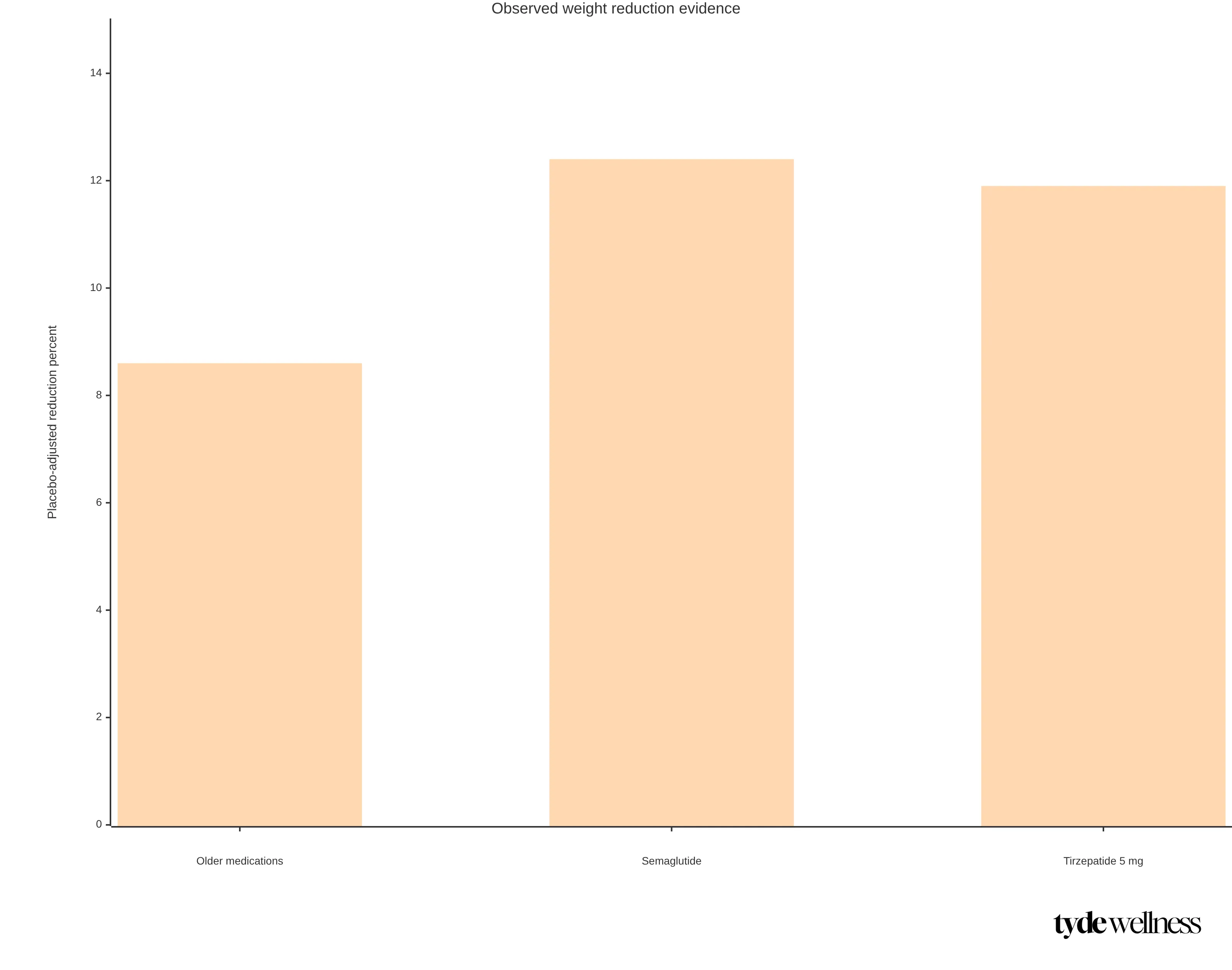
Next, identify the endpoint and dose. In the 15-mg group, 36.2% reached the prespecified exploratory endpoint of at least 25% weight reduction. The same passage reports a 12.4% placebo-adjusted reduction for semaglutide 2.4 mg, with nearly one third of participants losing at least 20%.
These figures describe results in particular study groups, not an individual prediction. The trial passage cautions that the tirzepatide and semaglutide results should not be directly compared because their populations and designs differed. Weight loss also varies with the medication, overall health, and other individual factors.
Use the worksheet to organize questions for clinician review rather than to rank medications. Keep the comparison focused on the same outcomes and timeframe. Do not place a result from one study beside a result from another study and assume the larger number identifies the better personal choice.
Practical fit deserves the same attention as the headline result. An option may look attractive on efficacy alone but require a routine, follow-up schedule, communication plan, or side-effect discussion that does not fit your circumstances. Another option may raise different questions. You can compare those demands without ranking either option before your clinician reviews your health information.
A simple worksheet can include these columns:
- Option or category under discussion.
- Intended role and outcome being followed.
- Study context and limits of the evidence.
- Administration and daily or weekly demands.
- Possible benefits and tolerability questions.
- Follow-up timing, monitoring, and change criteria.
- Treatment, medication, and follow-up costs to discuss.
Use the worksheet to make questions visible. Do not use it to self-prescribe or to fill clinical gaps with assumptions.
To make the worksheet useful when the evidence is incomplete, separate three kinds of statements. First, record what the cited study or guideline actually reports. Second, record what still requires medication-specific or personal review. Third, record the practical question that would resolve the uncertainty. For example, a study result can occupy the evidence column, while administration details, interaction questions, reproductive context, and follow-up expectations remain questions for the clinician rather than assumptions.
This distinction prevents an empty cell from being interpreted as either a benefit or a risk. It also keeps a general category description from standing in for medication-specific information. If two options are supported by different kinds of evidence, note that difference beside the result instead of forcing both into a single ranking. If a cost or access answer depends on the treatment route or individual circumstances, record what must be confirmed rather than treating an estimate as settled. The finished worksheet should show both what you know and what you still need to ask.
Read efficacy evidence without turning it into a promise
Efficacy evidence describes what happened in a defined study group under a defined protocol. It does not establish the result you will experience. In the same trial passage, 36.2% of participants in the 15-mg group reached the prespecified exploratory endpoint of at least 25% weight reduction.
Those figures have a precise scope. The 11.9% figure is the reported placebo-adjusted change from baseline in the 5-mg maintenance group; it is not a guaranteed individual result. The 30% figure measures the share of participants reaching at least 20% weight loss in that group; it does not mean that most participants reached that threshold. The 36.2% figure measures an exploratory endpoint in the 15-mg group; it does not establish a general outcome for everyone using that dose.
The cited passage also reports placebo-adjusted reductions of about 3.0% to 8.6% for older approved medications and 12.4% for semaglutide 2.4 mg, with nearly one third of semaglutide participants losing at least 20%. Those numbers belong to the cited passage’s study context, populations, and designs. Results from the cited tirzepatide and semaglutide trials should not be directly compared because their populations and designs differed.
When you read a percentage, ask what it measures before asking whether it is high or low:
- Is it an average, a proportion reaching a threshold, or an exploratory endpoint?
- Is it placebo-adjusted or an absolute change from baseline?
- Which medication, dose, population, and follow-up period produced it?
- Does the comparison use the same study design and population?
- What information would help your clinician translate the evidence into a reasonable monitoring plan?
A number can inform a discussion without becoming a forecast.
An evidence-based discussion should include your goals, medical history, current treatment, possible side effects, and follow-up plan rather than focusing on a single headline result.
Study results can help you understand the range and type of benefit researchers observed. They cannot tell you whether the same result will occur for you, whether you will tolerate the treatment, or whether the option fits the rest of your care. Keep those as separate questions.
Treat direct medication comparisons as limited evidence
Direct comparisons between tirzepatide and semaglutide remain limited in the cited meta-analysis. It identified two randomized controlled trials available for direct comparison and treated study design as a potential source of heterogeneity when retrospective cohorts were combined with clinical trials. The type of evidence therefore matters when you interpret a pooled result.
The cited tirzepatide trial passage makes a related point: its results and semaglutide trial results should not be directly compared because the trial populations and designs differed. A higher number in one study may reflect differences in participants, treatment protocol, follow-up, comparison group, or analysis rather than a simple medication ranking.
Use comparison claims as prompts for closer review. Ask:
- Were the medications tested directly against each other or in separate studies?
- Did the studies enroll similar participants and measure the same outcome?
- Were the treatment periods and doses comparable?
- Did one analysis combine randomized trials with retrospective real-world data?
- Does the comparison answer your question about fit, or only describe an average study result?
If the evidence cannot support a clean ranking, the practical conclusion is not that the options are identical. The conclusion is that your decision should include the quality and limits of the comparison, along with the clinical factors that affect your own treatment plan. A careful comparison can still be useful without producing a single winner.
Balance expected benefit against tolerability and personal fit
Potential weight-loss benefit is only one side of the decision. Medication may help promote and maintain weight loss as part of a comprehensive obesity treatment plan, but side effects and personal fit should be considered together. The amount of weight a person loses also varies with the medication, overall health, and other individual factors.
Tolerability is not a minor detail to check after choosing an option. It can affect whether you can follow the treatment routine, whether you need additional support, and whether your clinician considers a change in approach. Ask what side effects are associated with the option under discussion, which symptoms require contact with your care team, and what the plan would be if you cannot tolerate it. The available support for this comparison does not establish that any particular symptom will occur for you.
Personal fit includes more than symptom tolerance. Bring these practical details into the conversation:
- Your daily schedule and ability to follow the administration routine.
- Your food, activity, and support needs while appetite or weight changes are being monitored.
- Your current medications and any other treatment you may need to continue.
- Your preferences about follow-up, messaging, and how progress will be measured.
- The financial and access limits that could affect continuity.
- The outcome you care about most and the trade-offs you would find difficult to accept.
A reasonable choice is one that can be assessed and followed within your care plan. You do not need to declare a winner before those conditions are clear. If the potential benefit and practical burden point in different directions, make that tension explicit in the clinical discussion.
Make monitoring the test of whether the plan is working
Monitoring turns a medication choice into an evaluation process. The Endocrine Society guideline resource identifies monitoring progress during medication-assisted weight loss as part of obesity management. It also says treatment response should be reviewed after three months: continue medication when weight loss is at least 5% and the patient is responding well; consider stopping and changing the approach when it is ineffective or causes side effects.
The 5% measure refers to body-weight change after three months in the guideline resource. It is a treatment-response criterion in that recommendation, not a promise that you will reach it or a complete definition of success for every person. Your clinician still has to interpret the result alongside tolerability, health conditions, other treatment goals, and the full clinical picture.
Before starting, ask how monitoring will work:
- What will be measured besides weight, if anything?
- When will the first formal review take place?
- Which changes should you report between visits?
- What result would support continuing the plan?
- What side effect, lack of response, or practical problem would prompt an adjustment or a different approach?
- How will nutrition, activity, and ongoing support fit into follow-up?
A monitoring plan gives you a defined way to discuss progress instead of judging the treatment by day-to-day fluctuations. It also creates a boundary against continuing an ineffective or poorly tolerated approach without review. Ask how the plan will change if your response differs from the study results you have read.
One practical way to prepare for that review is to keep a brief record of the information your clinician has asked you to monitor. Note the date, the progress measure being followed, changes you want to discuss, any tolerability concerns, and questions about the treatment routine or support. The purpose is not to interpret the record on your own or to change treatment without guidance. It is to give the clinician a clearer account of what happened between reviews.
Bring the same comparison criteria to follow-up that you used before starting: intended role, possible benefit, tolerability, practical demands, and cost or access concerns. This makes it easier to distinguish a short-term question from a reason to reassess the plan. It also keeps the decision dynamic: continuation, adjustment, or a different approach should follow review of the response and the broader clinical picture, not a single day or isolated measurement.
We offer real-time messaging with our care team. If you are considering care through Tyde Wellness, include communication and follow-up in your questions about how support would work. This business-specific feature does not determine whether a medication is suitable for you.
Keep midlife and reproductive context inside the clinical discussion
Midlife and reproductive context belongs in the medication conversation because your clinician needs the information that could affect an individualized assessment. If you are experiencing perimenopause or menopause, describe the symptoms, changes, treatments, and weight-related goals you want addressed. If pregnancy, breastfeeding, or plans to become pregnant apply to you, raise that context before discussing a medication choice rather than treating it as a separate topic.
This discussion does not diagnose the cause of weight change or determine medication eligibility. It gives your clinician a fuller picture for reviewing possible benefits, side effects, other medications, and practical fit. Ask which parts of your health history need additional review before any treatment decision is made.
Bring a short context list to the appointment:
- Your current life stage and reproductive plans, if relevant.
- Changes in weight, appetite, activity, sleep, or health that you want to discuss.
- Current prescriptions, over-the-counter products, and supplements.
- Previous experiences with weight-management treatment or side effects.
- The outcome you hope to support and the constraints that could affect follow-up.
Use this information to improve the assessment, not to self-select a medication from a category label. If a life-stage or reproductive question is relevant, ask your clinician to explain how it affects the treatment discussion and what additional review may be needed.
Prepare questions before discussing treatment
A prepared question list helps you compare options on the same terms. Take these questions to a qualified clinician:
- Based on my health history and goals, which medication categories are reasonable to discuss?
- What is each option intended to do, and what evidence supports that role?
- What possible benefits should we monitor, and over what timeframe?
- Which side effects are associated with each option, and which symptoms should prompt contact?
- Do my current medications or health conditions change the assessment?
- Does my reproductive or midlife context require a separate review?
- How is the medication administered, and what routine would I need to follow?
- What will our follow-up measure?
- What would support continuing the plan, and what would lead to an adjustment or alternative?
- What are the treatment, medication, and follow-up costs, and what access conditions could affect continuity?
These questions reflect the need to consider side effects, personal fit, and monitoring rather than efficacy alone.
Bring the answers back to your comparison criteria. Write down the intended role, evidence context, administration demands, possible benefits, tolerability questions, monitoring plan, and practical requirements for each option discussed. If an answer depends on a test, examination, medication review, or additional history, record that as the next clinical step rather than filling the gap with an online assumption.
A clinician discussion should leave you with more than a product name. You should understand what is being considered, why it may fit the stated goal, how progress will be assessed, and what happens if the plan is ineffective or poorly tolerated. If those points remain unclear, ask for them before treating the option as a decision.
Before the appointment, organize your notes into three short parts: the outcome you want to discuss, the constraints that could affect treatment or follow-up, and the questions you cannot answer from general information. The outcome might concern weight management or another goal already raised with your clinician; it should not be turned into a promise about a particular result. Constraints can include daily routine, support needs, current treatment, reproductive context when relevant, and cost or access questions.
Then identify which answers you need before moving forward. Prioritize questions about whether an option is clinically appropriate, what information the clinician needs to assess it, how response and tolerability will be reviewed, and what would prompt a change in approach. This ordering helps separate eligibility from preference and preference from convenience. It also gives you a clear basis for deciding whether the next step is further evaluation, continued discussion, or no medication decision yet.
Read tirzepatide-versus-semaglutide evidence in context
The useful next step is to turn your medication search into a structured clinical conversation. Direct tirzepatide-versus-semaglutide evidence remains limited: the cited meta-analysis identified two randomized trials, and results from the cited trials should not be directly compared because their populations and designs differed. Avoid ranking options from separate studies, and treat every eligibility statement as a starting point rather than an individualized decision. We offer personalized medical weight loss services and provide GLP-1 and non-GLP-1 options for weight loss.
A qualified clinician must decide whether treatment is suitable for you, which option to consider, and how it should be monitored. Use the questions in this guide to prepare for that assessment and to understand what follow-up would involve.
Questions to ask before comparing weight control medications
What should I consider when discussing weight control medications with a clinician?
When discussing weight control medications, consider your health history, treatment goals, potential side effects, and how the medication fits into your overall weight management plan. It’s important to have a clear understanding of what each medication is intended to do and how it may affect your daily life.
What role does monitoring play in the use of weight control medications?
Monitoring is crucial in the use of weight control medications as it helps assess the effectiveness of the treatment, track weight loss progress, and identify any side effects. Regular follow-ups with your clinician can help determine if adjustments to the treatment plan are necessary.
How can I prepare for a discussion about weight control medications with my clinician?
Prepare a list of questions to ask your clinician, including inquiries about the intended use of each medication, potential benefits and side effects, and how your current health conditions may affect your treatment options. This will help ensure a comprehensive discussion.
What should I do if a weight control medication is not effective for me?
If a weight control medication is not effective, it is important to consult your clinician. They may recommend stopping the medication and exploring alternative options or adjusting your treatment plan based on your individual needs.

